Friday, December 19, 2014

The Hobbit: The Battle of Five Hours


But they were all of them deceived, for another trilogy was made. In the lands of New Zealand, in the fires of Warner Bros./New Line Cinema, the Dark Lord Peter Jackson forged, in secret, a master cleanse. And into this trilogy he poured his cruelty, his malice, and his will to CGI all life - One Trilogy to Bore Them All.


It’s hard to believe it’s been eleven years since the release of the final chapter of Peter Jackson’s masterful adaptation of The Lord of the Rings. To this day, the midnight showing of The Return of the King stands as the single greatest movie-going experience I have ever had. Seriously, it was like a sporting event – people were cheering and applauding through practically the entire film. If someone had approached me immediately after that viewing and told me that eleven years later a Hobbit movie would be released and I wouldn’t care less about it, I would never have believed them. How could I? The Lord of the Rings Trilogy is a masterpiece! Peter Jackson is a genius!

My, how times have changed.

Way back in the day when news was announced that The Hobbit would be split into three films, I was confused, but optimistic. I trusted Jackson and, despite the fact that the source material didn’t seem to merit three films, I put my faith in his judgment. Then An Unexpected Journey was released and all hope was lost. The film was a dreadful bore. Its nearly three-hour running length, made up of repetitive, video game style action sequences and non-existent character development, was mind numbing and further emphasized what a poor decision it was to split this story into three 3-hour length films. Its only saving grace was poor Martin Freeman, who did his utmost to portray the title character with all the zest and charm Bilbo Baggins deserves, despite being shoved to the side to play second fiddle to characters and events that weren’t even in the book.

A year later The Desolation of Smaug arrived. It still contained all the same problems as its predecessor, but it benefited from Jackson seeming to remember that entertainment should be, you know, entertaining. There were a couple of action sequences that actually managed to thrill – that barrel chase sequence, for one - but it still wasn’t enough to save the entire film from dullness or that complete ‘Eff You!’ of an ending. At the very least it wasn’t an outright travesty. It was certainly better than its predecessor, but only marginally so.

Now we come to it at last – the great battle of our time. At least, that’s what Peter Jackson would like for you to believe. Seriously, whose decision was it to try and push The Battle of Five Armies as ‘The Defining Chapter of the Middle-Earth Saga?’ Last time I checked, the ‘Defining Chapter of the Middle-Earth Saga’ was The Lord of the Rings. The Hobbit was never intended as anything more than a simple adventure story and its cinematic interpretation would have benefited greatly if it had followed suit. Instead, against all better judgment and/or logic, Jackson and co. decided to expand and bloat the charming tale of Bilbo Baggins’ adventures beyond recognition into something vastly unpleasant. And somehow, The Battle of Five Armies manages to be the worst part of this bloated trilogy.

After an enjoyable opening sequence (which is actually the missing ending of the last movie), things go downhill in splendid fashion. There are a lot of dull preparations for the Big Battle. We’re treated to superfluous subplots involving Bard, the hero of Laketown, (Played with admirable nobility by Luke Evans) and Legolas’s dad Thranduil (Played like a sleepwalker by Lee Pace) trying to convince the Dwarves to share Erebor’s treasure. Thorin (Played like a pouty five-year-old by Richard Armitage) is being altogether unpleasant due to a nasty bout of ‘dragon sickness’ (?). He refuses to play nice and spends a good chunk of the movie acting like a brooding brat before having a baffling, drawn out acid trip that brings him back to his senses.

But before Thorin can make up for all his nasty behavior, the Elves arrive with a massive army, joined by the citizens of Laketown, and engage in battle with a Dwarven army. Then a massive Orc army shows up to ruin all the fun and the armies engage in what can only be described as one of the most impressive video game sequences of all time.

In the meantime, Gandalf is having the time of his life being held in a cage by the Necromancer, a.k.a. The Lord of the Rings himself, Sauron. In one of the early comedic sequences of the film, Gandalf is rescued by some of our friends from the original trilogy: Galadriel, who has a full-on creepy girl from The Ring freakout moment, Elrond, who gets to relive his glory days of martial arts mayhem from The Matrix, and Saruman, who further emphasizes that Christopher Lee can still kick ass, as long as he’s played by a CG stunt double.

And absolutely nothing is at stake. Nothing. At the end of the day, all anyone in this movie wants is gold and they will fight to the death for it. If a character doesn’t want gold, they get the immense pleasure of watching the madness unfold from the sidelines.

And as I’m sitting there in the movie theater, watching these CG armies clash into each other over and over again, all I can think about is how much I miss the Peter Jackson who made one of the greatest trilogies of all time, and how little I care about anything that’s happening or any of the characters because this time around he has given me exactly no reason to do so. There is so little of significance happening here and yet it goes on and on and on as if it’s the most meaningful thing ever committed to celluloid. It’s painful.

And then in the midst of all this is Bilbo Baggins, who was supposed to be the main character of this story. Martin Freeman brings every ounce of charm to the screen he can muster; he’s these films’ one saving grace. But, as is tradition for this trilogy, Bilbo is shoved aside to make room for never-ending CG battles and subplots/characters that were of little importance in the novel. The fact that the last 10 minutes, which focus exclusively on Bilbo, are the film’s best says a lot about how wrong this whole enterprise went. Of course, we have to make room for that romantic subplot involving Tauriel, Legolas, and hunky Dwarf Kili. Who cares about Bilbo Baggins when you can watch these three pine over each other forever and ever, amen? Seriously though, whose idea was this? This love triangle has been one of the most absurd additions to these films and here it reaches levels of hilariousness I couldn’t possibly have imagined:

“If this is love…please take it from me,” cries Tauriel. “Why does it hurt so much?”

“Because it’s real,” answers Thranduil in typical deadpan fashion.

Cue the laugh track.

Really, the only advantages this final Hobbit film has over the other two in the trilogy are these:

  1. It has a shorter run time. (Yet somehow feels like the longest of the three)
  2. It’s blatantly stupid on a level that neither of the other Hobbit movies were. This makes it much easier to laugh at and that alone deserves to be commended.

Other than that, it’s financially-focused filmmaking at its most depressing. With The Lord of the Rings, Peter Jackson aimed to please by going for our hearts and minds. With The Hobbit, his aim is just as true, only this time he’s shooting for our wallets. And, in that regard alone, he succeeds.

FINAL RATING: 2/5

Friday, December 5, 2014

The Hunger Games: Mockingjay Part 1 really emphasizes the Part 1 over anything else


Before we get started, let me level with you on my opinions regarding The Hunger Games series. That way, you’ll know where we stand right from the get-go and, hopefully, no one gets hurt. Sound good? Cool.

I really enjoyed the first Hunger Games book. I read it in less than twenty-four hours and then immediately headed to the local theater to see the movie version. It was a worthy adaptation and I thoroughly enjoyed it. Despite liking both the book and the movie, I wasn’t much interested in continuing the series. It just didn’t grab me in the same way that The Lord of the Rings or Harry Potter did, but at the very least it was leagues better than those god-awful Twilight books/movies.

Eventually I got around to reading Catching Fire, which left me feeling not very...caught...on fire. It wasn't much more than a rehash of the first book’s events and Suzanne Collins’s prose just isn’t compelling enough to distract from the lack of fresh ideas. I went out to see the film adaptation of the book last year and was pleasantly surprised. Not only was it a major improvement over its source material, but it was leagues better than its predecessor. For once, I was actually excited about the franchise and the direction it was taking, despite the frustrating news that the final book would be arbitrarily split into two films.

I knew the third book was the most divisive amongst the series’ fans, but I was still willing to give it a shot. I moderately enjoyed the first half of the book, finding it more interesting than Catching Fire mainly due to the fact that it wasn’t just a rehash of the first book. Sadly, Mockingjay’s climax and ending had to go and ruin everything. It’s the very definition of underwhelming and, without spoiling particulars, is deeply unsatisfying in regards to the outcome of its plot and characters. Nevertheless, I was so impressed with the work that director Francis Lawrence, aided by his spectacular cast and crew, did with Catching Fire that I held out hope the film adaptation would improve on the mediocre nature of its source material.

So, good news first: Mockingjay Part 1 is without a doubt a major improvement over the book. Part of this is due to the fact that we don’t have to deal with Collins’ mind-numbing first-person narrative style writing, which makes Katniss come across as nothing more than an empty shell of a girl who has no idea who she wants to date more – the hunky Gale or the thoughtful Peeta. Seriously, we’re in the midst of a massive rebellion and all this girl can think about is which boy she likes more? So much for strong female characters. Thankfully, the screenplay forgoes the love triangle nonsense of the book. It’s mentioned only in passing and put to rest as quickly as possible. There’s not much question as to who Katniss really loves, so we don’t have to put up with all of her BS moaning about it.

Mockingjay’s screenplay sorely misses the talents of screenwriters Simon Beaufoy (Slumdog Millionaire; 127 Hours) and Michael Arndt (Little Miss Sunshine; Toy Story 3), both of whom were far more than Catching Fire’s source material deserved. Series newcomers Peter Craig (The Town) and Danny Strong (Lee Daniels’ The Butler), do a decent job of adapting the novel, making due with what they have. If the proceedings feel a bit less charming and a bit more straightforward this time 'round, it’s mostly due to the novel’s content more than anything else.

Truth be told, the best moments of the film are moments that aren’t even heavily featured in the book – a rebellious attack on a large dam set to Jennifer Lawrence’s haunting performance of ‘The Hanging Tree;’ a thrilling covert rescue mission sequence, which was only mentioned in passing in the book.

Despite the solid quality of the screenplay, there were a couple of baffling ‘on-the-nose’ moments – in one instance a character in a video broadcast shouts, “They’re coming for you! You’ve got to get out of there!” Immediately after the video shuts off, a character responds with, “It’s a warning. They’re coming for us,” as if it’s news to anybody. Not sure why that wasn’t left on the cutting room floor.

At this point, it’s no surprise that the cast is the shining beacon of this franchise. They elevate the material to heights way beyond the quality of the source material. Jennifer Lawrence gives another spectacular performance, instilling Katniss with a level of humanity and depth that was barely present in the novels. It's a shame her character becomes so passive this time around (And sadly, if the movie stays true to the novel, she won't have much more to do in Part 2). Liam Hemsworth is given a bit more to work with as Gale this time around and Josh Hutcherson, though barely present for most of the film’s running time, makes a major impact.

The supporting cast here is one of the finest seen in any film, let alone a big budget franchise. Everyone delivers quality work – Donald Sutherland returns as the ruthless President Snow, Woody Harrelson continues the ongoing charmfest that is his performance as Haymitch and Philip Seymour Hoffman reminds us of how much we’ll miss his remarkable abilities as an actor. New cast addition Julianne Moore manages to fit right in with these talents, but sadly isn’t given much more to do beyond a one-note characterization.

The film’s biggest drawback, outside of the inherent weaknesses of its source material, is the inexplicable decision to stretch the proceedings out over the course of two films. Mockingjay barely holds enough material for a single film, let alone two. Obviously, the suits at Lionsgate looked at The Hobbit, Harry Potter, and Twilight and saw the benefits of making people pay twice to see a single movie (or in The Hobbit's case even three times), but it’s such a shame they went the quantity over quality route considering how strong the franchise has been up to this point. It doesn’t entirely ruin the film, but it really emphasizes the Part 1 nature of the whole thing. It feels incomplete and it undermines the quality. This could have been a really strong ending for the trilogy, but instead we’re being served a haphazard mishmash.

Will Part 2 justify the split? I doubt it. The book’s 2nd half and ultimate outcome are incredibly weak and despite this franchise’s track record I seriously doubt the filmmakers will be able to rise above its shortcomings. For the time being, Mockingjay Part 1 offers serviceable entertainment for the franchise’s fans, but is a definite step back for the series overall.

FINAL RATING: 3.5/5

Wednesday, November 19, 2014

I Watched Dumb & Dumber To So You Wouldn't Have Too.

Before we get started, allow me a moment to address the elephant in the room: Yes, I’m aware I have not posted reviews for the biggest releases of the past month: Interstellar or Big Hero 6. Why haven’t I posted them? As of the composition of this particular review I have still not seen them. Which leads us to the next question: “You willingly chose to see Dumb and Dumber To over Interstellar or Big Hero 6? Or even Foxcatcher?? Or even Whiplash?!?!

I understand how this might look and I realize it may reduce whatever credibility I have as a film critic or blogger or whatever you want to call me, but please let me try to explain.

When it comes to the anals, *AHEM* excuse me, annals of low-brow comedies, Dumb & Dumber rests on the highest tier. It’s a comedy classic. Yes, it’s incredibly stupid, but there’s intelligence behind the humor, which is elevated to all kinds of heights by the spectacular performances of Jim Carrey and Jeff Daniels as Lloyd Christmas and Harry Dunne respectively. It’s also got quite a bit of heart. I happened upon this comedic goldmine when I was 14, which is pretty much the perfect age to see it. To this day I consider it to be one of the funniest movies ever made.

Let’s flash forward, shall we?

I’m twice the age I was when I first saw Dumb & Dumber and the Farrelly Brothers have seen fit to unleash a long overdue sequel. I was excited to see Jim Carrey and Jeff Daniels donning their signature hairdos and wardrobes in photos posted all over various social media outlets. My head screamed, “DANGER,” but my heart was filled with joy. I hoped beyond hope that the Farrellys would somehow regain the spark of comedic genius that gave us the original film. Through every underwhelming trailer and TV spot release, I held fast to my slowly dying belief that Dumb & Dumber To would, at the very least, contain a smidgen of the appeal that made the first one such a magical experience.

Sadly, this long overdue sequel contains exactly none of the charm of its predecessor. It’s cynical, mean-spirited and, most disappointing of all, not particularly funny. Truth be told, it’s not even much of an improvement over 2003’s Dumb and Dumberer: When Harry Met Lloyd. And when you can’t even top a cheap knockoff of your own film, it might be time to rethink your career. Watching Carrey and Daniels reprise these roles isn’t without its moments of delight, but it’s mostly just sad. They both seem to playing caricatures of their younger selves and, though they must be commended for throwing themselves back into these roles with great gusto, the whole enterprise feels incredibly depressing and desperate. I’ll admit I had a few chuckles, but the jokes very rarely hit their mark. They tend to go for the most obvious punchline, the most awkwardly offensive, or, even more frequently, the laziest. 'Lazy' is probably the best word to describe Dumb & Dumber To. The whole plot is recycled from the first film and so many of the jokes are taken practically verbatim.

There’s no way a 20-years-later Dumb & Dumber sequel could ever have lived up to its predecessor, but it’s like the Farrellys didn’t even bother trying. The whole thing reeks of cash cow stank at its most vile and it’s really sad considering that with a bit more care this could have been something really fun. Or, I don't know, maybe asking for the filmmakers to actually care about what they're doing is a bit too much.

If you really love the first film, do yourself a favor and re-watch it for free on Netflix instant streaming instead of going out to support this garbage. You’ll thank me later. I promise.

FINAL RATING: 1.5/5

**EDIT** As my diligent friend Arik pointed out, you're not technically watching Dumb & Dumber for free on Netflix since you have to pay for it. However, if you don't have Netflix, come on over to my place and we'll watch it for free together! It'll be a glorious occasion!

Friday, October 31, 2014

Take a bow, Birdman. You've earned it.


Every year, there are a small handful of films that remind you exactly why you fell in love with the medium in the first place. Last year that list included the likes of 12 Years a Slave, Before Midnight, Gravity, and Her, amongst others. This year we have Boyhood, Captain America: Winter Soldier, Chef, The Grand Budapest Hotel, and now you can add Alejandro González Iñárritu’s Birdman to the list; and, truth be told, Birdman could be the very best of the bunch. It is a masterful cinematic experience in every sense. Every element is top-notch, from the screenplay to the performances to Iñárritu’s guiding hand. It serves as a reaffirmation of what makes cinematic storytelling so special and is a gift to lovers of the artform.

And speaking of artforms, that’s exactly what Birdman is all about. It celebrates the artist’s inexplicable drive to create using the plights of Riggan Thomson (Michael Keaton) as a representation of the struggles every hard-working artist has faced at one point or another. Riggan is desperate to escape the shadow of his Hollywood career in which he was the star of the enormously successful ‘Birdman’ film series. To prove himself as a true ‘artiste,’ he’s taken it upon himself to direct and star in a Broadway adaptation of Raymond Carver’s 'What We Talk About When We Talk About Love.' Along the way, he’ll have to find a way to bond with his daughter, who’s fresh from drug rehab (Emma Stone), while appeasing the two actresses in his play: his somewhat-of-a-girlfriend Laura, who’s claiming she’s pregnant with his kid (Andrea Riseborough) and the aspiring Broadway star Lesly (Naomi Watts). He’ll also have to deal with the mad devotion and all-around insanity of method actor extraordinaire Mike Shiner (Edward Norton), all the while fending off the skeptics in the press who are determined to ruin his foray into ‘serious’ acting and his many fans who just want him to do another 'Birdman' flick.

The screenplay by Alejandro González Iñárritu, Nicolás Giacobone, Alexander Dinelaris, Armando Bo is equal parts introspective, beautiful, disturbing, and tragic. It’s also frequently hysterical. There is so much going on, so many tones and characters, so many different storylines to juggle, that you expect the whole enterprise to either collapse under its own weight or derail in splendid fashion, Thanks to Iñárritu’s direction, it does neither and never feels anything less than a totally exhilarating viewing experience. The entire film is staged as a one shot sequence. The discerning eye will notice where the cuts are employed, but no one can deny how seamless the effect is thanks to the incredible direction and editing. Iñárritu has clearly been inspired by his best bud Alfonso Cuaron’s technique, even employing Cuaron’s go-to Director of Photography Emmanuel Lubezki. Lubezki continues to solidify his place as one of the finest cinematographers working in the trade and his work here is frequently stunning. Antonio Sanchez’s score thumps and jives and bounces all around like its own character, always complimenting, never detracting. It’s one of the best soundtracks of the year.


Sometimes films that revel in their technical triumphs end up favoring the technique over the story and characters, but with Birdman, Iñárritu has struck a perfect balance between these elements. This is due, in no small part, to the remarkable cast he’s assembled. Everyone here, from the major roles all the way down to the most minor, delivers some of the best work I’ve ever seen from them. Michael Keaton is the obvious stand out as tortured actor Riggan Thomson. This could be the best performance of his entire career. I can’t say for sure; I’ve never seen Mr. Mom or Multiplicity. Obviously it’s not too difficult to see the parallels between Keaton’s career and that of the character he’s playing. It’s unquestionably one of the best performances of the year and it’s sure to garner some much-deserved awards attention. Edward Norton gives a superb, madcap performance as Riggan’s ‘nemesis’ Mike Shiner. Norton has a ball with the character. If you’re already in love with Norton’s work, you’re only going to discover more reasons to love him here. Emma Stone gives yet another exquisite performance as Riggan’s daughter Sam. She continues to prove herself as an amazing talent, going beyond her standard adorable, wise-cracking persona to deliver something much more profound. It would be rather lovely to see her get some awards attention when the season rolls around. Naomi Watts and Andrea Riseborough are gorgeous and work wonders in their supporting roles; Zach Galifianakis is yet another welcome addition, meeting the high standards set by the rest of the cast. Amy Ryan as Riggan’s ex-wife Sylvia may not have much screen time, but she leaves an indelible impression.

Birdman is a masterpiece. It really is and despite its exhaustively spectacular technical side, it still manages to come across as unassuming and modest. I adored every single second of this film. It belongs near the top of the best films of 2014 and, I’ll go ahead and call it now, one of the best of the decade. There is something inherently human about Riggan’s struggles to find meaning in his life and his work and his story is one that is sure to go down as one of the most beloved of all time.

So, if you've read this review and you're still not convinced, I'll just leave this image here. It should provide the final push you need:


FINAL RATING: 5/5

Friday, October 10, 2014

Happy 50th Birthday to master filmmaker Guillermo del Toro! Let's Rank His Filmography.


Guillermo del Toro is one of the most imaginative and gifted filmmakers of this day and age and one of my personal, all-time favorites (As if you didn't already know). His imagination seems to know no bounds and we, as audience members, are the beneficiaries of his willingness to share it with us. Not only is del Toro an extraordinary talent, he comes across as intelligent, genuine, and incredibly humble. He has an enormous heart to match his lovable girth. Just watch the below Colbert interview and try to convince me you don’t want to give this guy an enormous hug, even as he discusses horrifying monsters and viruses.


This beautiful man turned 50 yesterday. I’ve decided to celebrate his remarkable career by ranking all of his films. Let’s start with the bottom of the barrel, shall we?


8. MIMIC (1997)

Yes, this is the one with the giant cockroaches. After achieving breakthrough success and acclaim with his first feature Cronos, del Toro was hired by the ‘Suits’ to make his first big Hollywood picture. Mimic's production was a disaster practically from start to finish. del Toro and the Suits never saw eye-to-eye on what the film could/should be and del Toro’s ambitions and imagination were cut off at every turn in order for Mimic to become more of a generic ‘big cockroach’ monster-fest. Second Units were employed to add additional, cheap scares against del Toro’s wishes (He insists on being behind the camera for every single shot, no matter how throwaway) and the producers snatched away his final cut privileges. Thankfully, del Toro had a chance to revisit and recut the film, bringing it closer to his original vision. His Director’s Cut is certainly an improvement, but not enough to save Mimic from being his weakest effort.


7. BLADE II (2002)

I can’t quite explain it, but when I was 16 I developed a crazy obsession with seeing the Blade movies. Coming from a conservative, Christian household, it was no easy feat to try and convince my parents that I should be able to watch them. As a last-ditch effort, I mentioned my desire to see Blade II to my friend Angie during one of our high school theater classes. (For some reason I wanted to see the second Blade more than the first…it just looked cooler) She had asked me if there was anything she could get me for my birthday and I jokingly suggested a copy of Blade II on DVD.

A few weeks went by and my birthday had come and gone. Day after day, Angie insisted she had gotten the movie for me, but had kept forgetting to bring it to school to give it to me. I shrugged it off, figuring she hadn’t really gotten me the movie and was just putting off admitting it. Then one day, she came to class, marched right over to me and handed me Blade II on DVD. I couldn’t believe it. I thanked her profusely and as soon as I got home I popped it into my DVD player.

Blade II carries the distinction of being the first Guillermo del Toro film I ever saw. Now, I admit, none of the Blade movies are particularly outstanding, especially not the God-awful third one. But, at the very least, the first two are tons of fun. Wesley Snipes is a total badass and the action sequences are on point. Blade II bests its predecessor primarily because of del Toro's visual direction. When he was hired, he reportedly told Snipes, “Look, I don’t get Blade. I don’t get the character – that’s your territory. I’ll handle the monsters, you handle Blade.” And handle the monsters he did. The Reapers are one of del Toro’s most inventive, terrifying creations and extremely effective as the primary villains of the film.

Outside of the action sequences and the visuals, Blade II kind of falls apart. It's got a goofy soap opera-esque story and the characters aren't developed beyond their generic stereotypes. But, really, did you expect to gain anything profound from a Blade movie? It’s a lot of fun and unquestionably the best of the Blade trilogy.


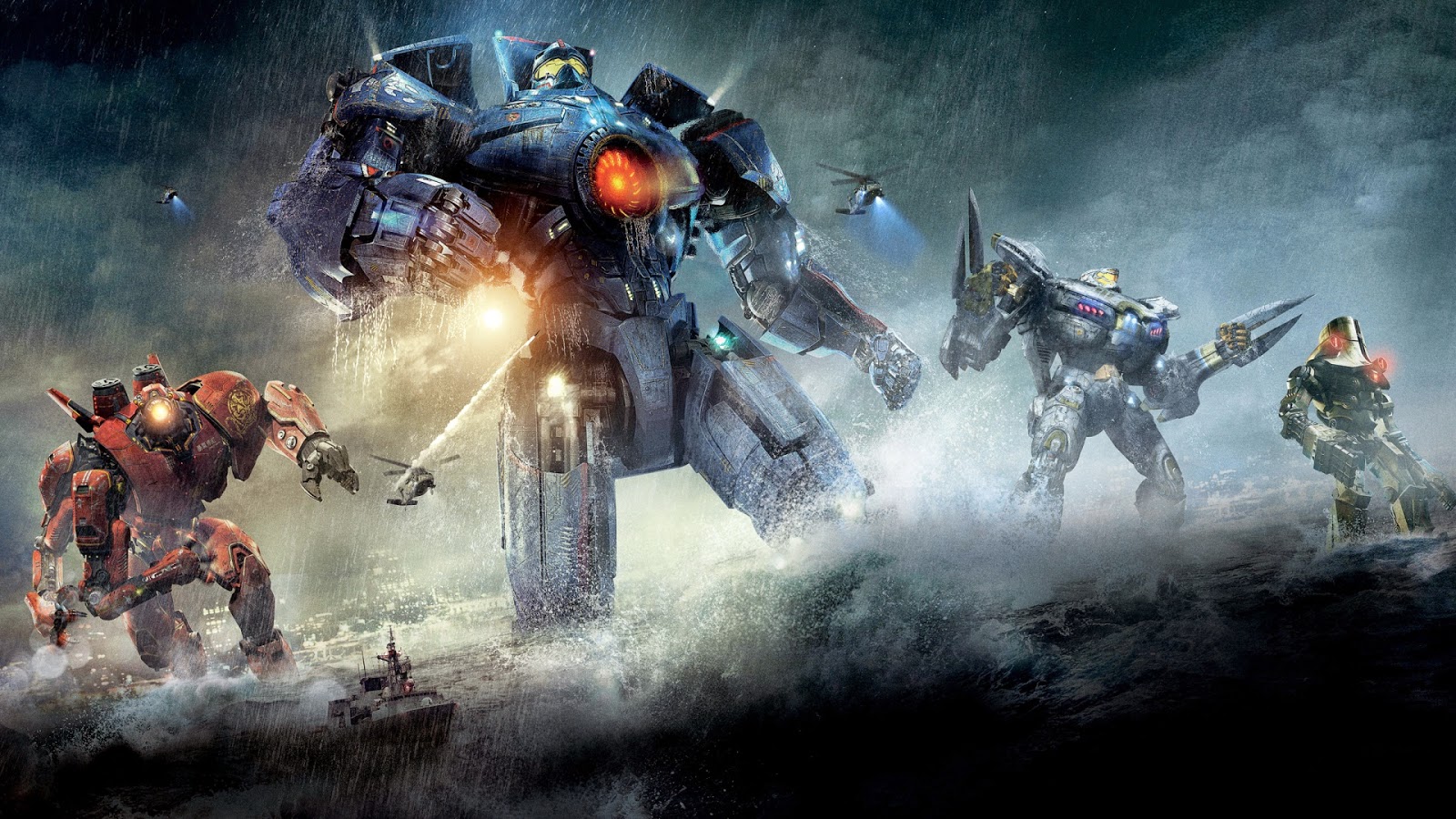
6. PACIFIC RIM (2013)

All I needed to hear about Pacific Rim was that it was a movie about giant, human-operated robots fighting gargantuan monsters directed by Guillermo del Toro to be 100% on board. Pacific Rim carries the distinction of being del Toro’s biggest production yet (Thank you, movie gods, for seeing fit to provide him with a $200 million budget) and although it wasn’t a major success state-side, its worldwide box office success was enough for Legendary Pictures to greenlight a sequel and an animated series. Pacific Rim shows what happens when del Toro has the means to fully unleash the 10-year-old, monster loving child that drives who he is as a person and a filmmaker. It is full of crowd-pleasing, monster bashing action and beautiful, colorful images. It’s also got a kick-ass soundtrack:


Pacific Rim’s plot and characters are a bit paper thin, but again, when it comes to these kinds of films those elements always have a tendency to take a backseat. Let’s hope that the sequel allows for a bit more development of these items in addition to even grander and more spectacular Jaeger/Kaiju smackdowns.


5. CRONOS (1992)

del Toro’s first feature film is one of the strongest debuts I’ve ever seen. His unique take on the vampire genre showcases his blossoming talent for striking, memorable visuals and poetic, fairy tale-esque storytelling. It’s creepy, disturbing, tragic, and ultimately beautiful. It also marks the first time del Toro worked with the immensely talented and all-around glorious human being Ron Perlman. Considering the limited resources at his disposal, it's remarkable that del Toro was able to pull this off as well as he did. It's a strong start to an incredibly fruitful career.


4. HELLBOY (2004)

Hellboy is one of the greatest comic book movies of all time and it deserves way more recognition than it's gotten. Seriously, everyone’s talking about how wonderful and subversive Guardians of the Galaxy is, but del Toro beat the Marvel Cinematic Universe to the punch with his 2004 adaptation of Mike Mignola's popular cult-favorite. Hellboy had the disadvantage of being released amongst a slew of other superhero flicks (It was sandwiched between 2003’s X2: X-Men United and 2004’s Spider-Man 2), which probably contributed to its lukewarm box office response, but it truly belongs in the same league as those beloved comic-book adaptations.

This really was an ideal example of a filmmaker being perfectly matched to the source material. Hellboy is zany, exciting, scary, and chock full of spectacular creatures and visuals. It was also the first time del Toro managed to infuse one of his big-budget films with the heart and soul of one of his smaller efforts. Hellboy is a visual feast for sure, but it’s special because of its incredible characters and enormous heart. del Toro owes a great debt to Ron Perlman whose perfect casting was the equivalent of Christopher Reeve’s as Superman or Robert Downey Jr.’s as Iron Man. Perlman was born to play this role and he knocks it way, way, way out of the park. His wise-quipping, seen-it-all-before, cigar-chomping attitude is charming beyond all reason and it is an absolute joy to watch.

Seriously, if you haven’t seen Hellboy since its release, I strongly suggest you revisit it. It is one of the very best comic book adaptations of all time and one of the most inventive and enjoyable action/sci-fi flicks ever made.


3. THE DEVIL’S BACKBONE (2001)

After the creative roadblocks and frustrations he experienced during the production of Mimic, del Toro was determined to return to his roots with his next film. He was actually offered the chance to direct Blade II after Mimic, but he insisted that he be allowed to make a more personal film outside of Hollywood in his home country first. Thankfully, New Line wanted him for the Blade II directing gig so badly, they agreed to wait until del Toro was ready. With no ‘evil’ Hollywood execs blocking his way during the production, del Toro ended up making one of his finest films.

The Devil’s Backbone shares many elements with its spiritual sequel Pan’s Labyrinth. Its story deals with the aftermath of the Spanish Civil War, it focuses on a young child dealing with supernatural forces weaving their way through a real world setting, and its human villains are more cruel/frightening than the supposed monsters. del Toro has always stated he felt The Devil’s Backbone was Pan’s Labyrinth’s equal and I’m inclined to agree with him. It is a masterfully crafted, deeply moving horror film – one of the very best of its genre. It’s memorable, frightening, and beautiful, and if you haven’t seen it yet, get to it! It’s mandatory Halloween horror movie viewing.


2. HELLBOY II: THE GOLDEN ARMY (2008)

Hellboy II is a Guillermo del Toro film on crack and I mean that as the absolute highest form of praise possible. Like its predecessor, Hellboy II was released at an awkward time – a week before The Dark Knight. Of course, once The Dark Knight was unleashed on the world, it wiped the floor with any and all competition and Hellboy II was one of its unfortunate victims. This was a time when audiences wanted more serious superhero fare and Nolan’s Batman films provided that in spades. A colorful, batshit crazy effort like Hellboy II was totally against the norm and, therefore, despite a very positive critical response, it was largely shunned and/or ignored by audiences.

Revisiting Hellboy II, I was struck by just how ahead of its time it was. Again, I’ve gotta call out the fact that del Toro basically beat the Marvel Cinematic Universe to the punch when it comes to making more inventive, bizarre, funny, and outlandish comic book flicks. And, truth be told, nothing in Marvel’s universe comes remotely close to meeting Hellboy II’s astonishing level of creativity. It is a stunning piece of work, light years ahead of the first Hellboy.

The sheer breadth of the production design is mind-boggling. If there’s any one movie that proves del Toro’s unprecedented gift for visual genius, it’s this one. Pause the movie at any given time and marvel at the intricate details of one of the most richly designed and imaginative universes ever committed to film. Of course, Ron Perlman is magnificent as always, as is the supporting cast, which features Doug Jones, Selma Blair, Jeffrey Tambor, Luke Goss, Anna Walton, and Seth MacFarlane doing the only noteworthy work of his entire career.

If there is any kind of justice in this world, we will get a Hellboy 3. I would trade nearly every superhero film scheduled for release in the next five years just to get one more Hellboy movie. I cannot stress this enough: if you haven’t seen Hellboy or Hellboy II or just haven’t revisited them in a while, you need to do so immediately. These are two of the greatest comic book adaptations of all time and deserve to be recognized as such and del Toro and Perlman deserve a chance to give movie fans the big finale this series more than deserves.


1. PAN’S LABYRINTH (2006)

Pan’s Labyrinth takes everything that has defined del Toro’s career up to this point and combines it in a cinematic expression that took our breaths away. It is, quite possibly, his finest realized and most beautiful work to date. The consensus is that it’s his magnum opus, and I’m inclined to agree with it. There’s just so much to love and admire here; it’s almost impossible to wrap one’s head around it. It showcases some of del Toro’s greatest fantastical creations (the faun, the pale man, etc.) and juxtaposes them with a brutal real world, a world which our heroine is desperately attempting to survive and escape to achieve her true calling. Pan’s Labyrinth carries all the elements of a classic fairy tale story as only Guillermo del Toro can tell it. It’s haunting, disturbing, and violent. It’s also stunning in every conceivable way - a visual poem. An unforgettable masterpiece.

Monday, October 6, 2014

Gone Baby Gone Girl


I read Gone Girl based on my girlfriend Sarah’s recommendation; she was adamant it was one of the best things she’d ever read. I’d just finished an underwhelming detective story - The Cuckoo’s Calling, published under J.K. Rowling’s male pseudonym Robert Galbraith, and was hardly looking forward to starting another novel that seemed to stem from the same genre. Nevertheless, at Sarah's insistence, I decided to pick Gone Girl up and I’m glad I did. From start to finish, it is a riveting read. The twists and turns keep you guessing all the way through its disturbing conclusion, but what really made Gone Girl so special were its spectacular characters and refreshing sense of humor. Gillian Flynn immediately shot to the heights of my favorite authors, (which, in case you’re wondering, should be considered quite an honor for any hardworking author) and Gone Girl became one of my all-time favorite books.

Of course, part of my motivation for reading Gone Girl sooner rather than later was driven by my knowledge of the film adaptation. I knew David Fincher was attached to direct and with him would come his reliable crew, but it’s harder for me to go back and read a book after seeing its cinematic adaptation. I was a bit nervous about how the novel, which alternates back and forth between its two leads' perspectives, would translate. I was pleasantly surprised to see that Gillian Flynn would be penning the screenplay, adapting from her own work. The final product is a superb thriller. If it doesn’t quite reach the heights of its source material, it’s no matter; it’s still masterful filmmaking and one of the year's best films.

Nick and Amy Dunne are your standard, good-looking, hip and happening young married couple. They’ve just reached their fifth anniversary and Nick is gearing up for another one of Amy’s traditional, romantic scavenger hunts. He gets more than he bargained for when he arrives at home to find his wife is missing and evidence of a violent struggle. Naturally, Nick is singled out as the prime suspect in his wife’s disappearance and his life begins a downward spiral that will reveal all kinds of fun goodies about their not-so-perfect relationship.

If you’re worried I’ll reveal any of the shocking developments of Gone Girl’s plot, don’t fret; I would never dare spoil the delightfully disturbed twists and turns that await you. All you need to know is you will have a grand old time falling down this topsy-turvy rabbit hole. The whole concept of marriage and the concept of what makes a successful one is ripped to shreds, its innards examined in intricate detail for all to see. And make no mistake, Nick and Amy Dunne’s relationship is one that demands to be seen.

Everyone involved with this film from cast to crew fire are firing on all cylinders. Flynn’s screenplay is incredibly faithful to her source material, but not too a fault. Flynn has a strong understanding of the nature of cinematic storytelling and adapts her novel to meet those standards in a way that makes the material feel fresh and invigorated. Her twisted sense of humor thankfully remains intact.

Ben Affleck’s performance as Nick Dunne goes down as a career best and one of my favorite performances of 2014. Rosamund Pike is excellent as Amy Dunne, though I did feel a nagging disappointment at her rather disconnected portrayal of the character. There isn’t as much of an element of the fun-loving ‘cool girl’ she was when she and Nick first met each other and it makes her character less empathetic. Still, Pike’s performance is sure to garner some way overdue Oscar favor. The supporting cast is equally superb. Carrie Coon’s performance as Nick’s sister Margo and Tyler Perry’s as celebrity lawyer Tanner Bolt were my particular favorites, and Kim Dickens and Patrick Fugit as the officers first assigned to Amy’s case are fantastic. Also, gotta love Neil Patrick Harris as a creepy ex-boyfriend.

On a technical level Gone Girl is glorious, which shouldn't be much of a surprise when you consider the talent behind the camera. It might not reach the highest ranks of Fincher’s filmography, but that’s not really a complaint considering the sheer breadth of modern masterpieces he’s directed in the past couple decades. (Alien 3 is definitely at the top of that list.…Sorry, I thought that would be funnier than it really is.) Fincher brings his top-notch crew with him as well, which includes the likes of Cinematographer Jeff Cronenweth (Get this man an Oscar already!), Editor Kirk Baxter and the haunting musical stylings of Trent Reznor and Atticus Ross. Everything meshes splendidly, resulting in a glorious, hypnotizing viewing experience.

It doesn’t matter if you have or haven’t read Gone Girl; David Fincher’s adaptation is going to wow you either way. It’s yet another worthy entry in his filmography and a fine notch on the belts of everyone involved. (Affleck’s career continues its impressive upward swing) Expect to see it on many a top-ten films of 2014 list as the year winds down and to be a front-runner for recognition come awards season. This is thrilling cinematic entertainment at its finest.

FINAL RATING: 4.5/5

Wednesday, October 1, 2014

Finding My Way Through The Maze Runner


To be perfectly honest, I wasn’t much looking forward to my viewing of The Maze Runner. Not that I had anything against the source material (I’ve never read the books) or even the trailers for that matter; those had at least stirred my interest. I’m just not usually onboard with the whole Young Adult thang and the recent onslaught of Young Adult adaptations has resulted in a large number of underwhelming films. The Maze Runner seems to fit right in with the genre’s latest trends. Despite the fact that James Dashner’s novel was released a year before Suzanne Collins’ first Hunger Games book was published, the cinematic iteration of his novel can’t help but seem like a B-Side to The Hunger Games film franchise. I was pleasantly surprised to find that The Maze Runner is actually a solid adventure flick, which stands on its own feet moderately well. It was exciting enough to keep my interest through its near two-hour running length thanks to strong direction and solid performances from its young cast and manages to thrill despite the sneaking suspicion that we've already seen everything it has to offer.

The plot follows a boy named Thomas (Dylan O’Brien) who wakes up on an elevator with no memory of who he is. He’s deposited into a community of around 60 or so young men who have experienced the same memory lost. They've adapted and learned to live in their environment – a glade/forest surrounded by enormous concrete walls. Those walls house a sinister maze, which opens up to the boys early in the morning and closes its doors when the sun goes down. The boys believe the way out of their prison lies somewhere within the maze, but no one who has been trapped inside the maze overnight has lived to tell the tale. Plagued by strange dreams of his past, Thomas is determined to conquer the maze in order to free himself and his fellow captives and figure out just why the hell they were imprisoned there in the first place.

The Maze Runner’s story is kind of a hybrid of The Hunger Games and The Lord of the Flies, but without the compelling characters or social commentary of either of those novels. What it lacks in original ideas and characters, though, it certainly makes up for with thrilling, expertly crafted action sequences. Considering this is his first foray into big screen territory, I was very impressed with director Wes Ball’s ability to craft genuinely suspenseful sequences. The first two acts are the strongest. Ball does a great job building tension and the mystery of the maze and when we finally get to see it in all its glory, it doesn't disappoint. There are some really cool set pieces here. Things fall apart in a weaker third act where certain characters unceremoniously bite the dust and certain secrets are revealed in underwhelming fashion in order to prepare for the inevitable sequel.

The performances are strong throughout. Dylan O’Brien makes for a likeable protagonist. He isn’t given much to do in the beginning besides asking your standard audience surrogate questions, but he makes it work and really comes into his own as Thomas’s character grows from being a confused bystander to a courageous leader. The supporting cast is strong too. The only casualty here is Will Poulter and his portrayal of the ‘antagonist’ Gally. Poulter isn't given much to work with, as Gally doesn't get much to do except complain about how Thomas is ruining everything the group has established in the years they've been trapped there. Maybe I’m exaggerating, but the guy has, like, 50 speeches that are practically identical. “Thomas needs to be punished! He broke the rules! He’s ruining everything! We can’t trust him!” And so on and so forth. Poulter does what he can with the limited characterization, but is overwhelmed in the end by the shoddy writing.

I won’t tell you to rush out and see The Maze Runner if you don’t already have some form of interest in the material. Really though, you could do much worse, considering how little there is to see in theaters at the moment – at least until Gone Girl is released on Friday. The Maze Runner is serviceable entertainment that doesn’t quite transcend its lack of originality or its absence of compelling characters, but it manages to get by despite these faults, delivering an exciting, albeit somewhat throwaway piece of entertainment.

FINAL RATING: 3.5/5