I wanted to post my top ten films of 2013 much, much earlier, but I hadn't gotten around to seeing the majority of the ones I wanted to see. At this point though, I've finally seen the majority of the nominees and I feel like I can form a pretty solid top ten. Additionally, I've listed a few of my Oscar predictions - what will win and what should win. (Because that seems to be the popular format these days and I'm far too lazy to rebel against the norm) Enjoy!!
THE ONES I MISSED:
The Act of Killing
All is Lost
Blue is the Warmest Color
Dallas Buyers Club
Frances Ha
Fruitvale Station
The Great Beauty
The Hunt
Short Term 12
Stories We Tell
HONORABLE MENTIONS:
Big Sur
Don Jon
Hunger Games: Catching Fire
Inside Llewyn Davis
Iron Man 3
Kill Your Darlings
Pacific Rim
Prisoners
The Spectacular Now
This is the End
Trance
The Way Way Back
The World’s End
THE BEST OF THE BEST (In ascending order):
10. AMERICAN HUSTLE –
A Scorsese wannabe of the finest order. David O’Russell delivers a fun,
zany look at the world of con-artists. This is probably the most overrated of the Best
Picture nominees but it’s hard to resist its manic energy and great
performances.
9. THE WIND RISES – Hayao
Miyazaki’s swan song is more thematically subdued than his other works, but
just as visually stunning. It is a fitting finale for the career of the world’s
greatest living animator.
8. THE WOLF OF WALL
STREET – Pure, unadulterated, obscene insanity and I loved every single one
of its 180 minutes. Scorsese is still churning out the goods like no other and Leo DiCaprio
delivers one of his very best performances.
7. PHILOMENA – I ended
up enjoying this much more than I thought I would. It was incredibly moving and
frequently hilarious. Great screenplay and great performances from Judi Dench
and Steve Coogan.
6. HER – An
exceptional, deeply felt take on love and relationships. Spike Jonze knocks yet
another one out of the park and the performances of Joaquin Phoenix and
Scarlett Johanssen are spectacular.
5. CAPTAIN PHILLIPS –
One of the most gripping thrillers I’ve ever seen. Paul Greengrass’s
direction sets the intensely realistic mood and Tom Hanks gives one of the
finest performances of the year, which, naturally, disqualifies him from Oscar
attention.
4. MUD – Matthew
McConaughey may have the Best Actor Oscar in the bag this year for his
performance in Dallas Buyers Club, but I’m rather fond of his performance in
this superb coming-of-age tale written and directed by one of my favorite
filmmakers Jeff Nichols.
3. 12 YEARS A SLAVE –
Emotionally devastating and undeniably powerful. Expertly directed by Steve
McQueen and featuring incredible performances from Chiwetel Ejiofor, Lupita
Nyong’o and Michael Fassbender. It is an unforgettable viewing experience.
2. GRAVITY – Sure,
the backlash is riding high at this point in the Oscar race, but Gravity is
single-handedly one of the greatest cinematic experiences of all time
and the strongest argument for the use of 3D I have ever seen. Alfonso Cuaron
continues to prove why he is one of the greatest working filmmakers of this day
and age.
1. BEFORE MIDNIGHT – The
third part of one of the greatest trilogies of all time may actually be the
best of the series. I can only hope Richard Linklater, Ethan Hawke and Julie
Delpy continue churning these out every nine years, as they are, without
question, the most honest and refreshing cinematic depictions of love I have
ever seen.
AND NOW FOR A FEW OSCAR PREDICTIONS:
BEST PICTURE:
What will win: 12 Years a Slave
What should win: Gravity
BEST DIRECTOR:
Who will win: Alfonso Cuaron - Gravity
Who should win: Alfonso Cuaron - Gravity
BEST ACTOR:
Who will win: Matthew McConaughey - Dallas Buyers Club
Who should win: Chiwitel Ejiofor - 12 Years a Slave
BEST ACTRESS:
Who will win: Cate Blanchett - Blue Jasmine
Who should win: Sandra Bullock - Gravity
BEST ACTOR IN A
SUPPORTING ROLE:
Who will win: Jared Leto - Dallas Buyers Club
Who should win: Michael Fassbender - 12 Years a Slave
BEST ACTRESS IN A
SUPPORTING ROLE:
Who will win: Lupita Nyong’o - 12 Years a Slave
Who should win: Lupita Nyong’o - 12 Years a Slave
BEST ORIGINAL
SCREENPLAY:
Who will win: Eric Warren Singer, David O. Russell - American
Hustle
Who should win: Spike Jonze - Her
BEST ADAPTED
SCREENPLAY:
Who will win: John Ridley - 12 Years a Slave
Who should win: Richard Linklater, Julie Delpy and Ethan Hawke -
Before Midnight
BEST ANIMATED
FEATURE:
What will win: Frozen
What should win: The Wind Rises
BEST CINEMATOGRAPHY:
Who will win: Emmanuel Lubezki - Gravity
Who should win: Emmanuel Lubezki - Gravity
BEST ORIGINAL SCORE:
Who will win: Steven Price - Gravity
Who should win: Steven Price - Gravity
BEST FILM EDITING:
Who will win: Adam Baumgarten, Jay Cassidy and Crispin Struthers - American Hustle
Who should win: Adam Baumgarten, Jay Cassidy and Crispin Struthers - American Hustle
With Kiki’s Delivery Service, Miyazaki continues in the vein
of the relaxed storytelling method he utilized in My Neighbor Totoro. By that I
mean he doesn’t focus so much on plot as he does on character and location.
It’s not quite the rousing success that My Neighbor Totoro was and it’s not one
of my personal favorites of his filmography, but it’s still decent and lovely
to look at.
Kiki is a witch in training and has just reached her 13th
birthday. When a witch reaches the age of 13, they embark on a sort of
coming-of-age pilgrimage in which they find a town or city that requires their
assistance and offer aid however they can. Upon arriving in the town of Koriko
with her best friend – a talking cat named Jiji, Kiki is befriended by a
kindhearted woman named Osono who runs a bakery with her husband and, in
exchange for helping around the shop, is allowed to stay in a room on the
property.
She begins to run her own personal delivery service, flying baked
goods and presents all over town. As she works, she meets all kinds of new
people such as the artistic young painter Ursula who lives in a cabin in the
forest and a kind-hearted old woman. All the while Kiki dodges the advances of
a goofy young boy named Tombo who has a huge crush on her and an obsession with
aviation. During her time in Koriko, Kiki strives to discover her purpose and
gain a sense of self-confidence.
It’s funny, despite dealing with the ‘magical’ subject
matter of a witch in training who has a talking cat and flies around on a broomstick,
Kiki’s Delivery Service is Miyazaki’s most grounded outing yet. The animation
is more straightforward and not quite as evocative or as memorable as in his
previous films and while the aimless nature of My Neighbor Totoro’s plot worked
in its favor, here it just comes across as a bit dull and meandering. Nevertheless,
Kiki’s Delivery Service still carries Miyazaki’s trademarks of charming
characters and beautiful animation and manages to entertain without being quite as successful as his previous films.
My Neighbor Totoro’s greatness is partially due to its
ridiculously simplistic nature. There’s barely a plot, little to no
conflict and not much excitement to be found. Despite this, it is one of
Miyazaki’s most essential works and contains limitless amounts of charm and
wonder. It’s one of the most endearing films I've ever seen.
My Neighbor Totoro follows the exploits of two sisters,
Satsuke and her younger sister Mei. They’ve just moved into a new house with
their dad which brings them closer to the hospital in which their mother is
currently recovering from a long-term illness. Satsuke and Mei spend much of
their time exploring and end up stumbling upon a magical forest in which dwells
a giant teddy bear like creature known as Totoro.
The plot doesn’t get much more complex than that, but in the
wake of the slightly more convoluted plots of Nausicaa of the Valley of the
Wind and Castle in the Sky, that's not a bad thing. My Neighbor Totoro is
more concerned with evoking a specific nostalgia for a long-lost time and place
that perhaps never existed and celebrates the joy of childhood and imagination.
Sure, it doesn’t make for the most thrilling movie-watching experience, but it
doesn’t need to thrill in order to be enthralling. The animation is gorgeous as
always; Totoro and the Cat Bus are such unique characters, proving once again
that Miyazaki’s imagination has no equal and the two main characters’
mannerisms are absolutely adorable and incredibly life-like.
The general carefree nature of the story and its wonderful
characters make it the best film in Miyazaki’s career up to this point.
Castle in the Sky is an improvement over its predecessor Nausicaa
of the Valley of the Wind in nearly every way. The animation is more
sophisticated and imaginative; the characters are more likable and their
relationships with one another are better developed and more compelling; the
plot is more complex without becoming too convoluted. It’s another fine work
from the master of Japanese animation.
The main storyline follows Sheeta, a girl with a mysterious
past and a magical pendant that gives the power of flight when the need is
dire. After falling from an airship and floating unconscious to the ground, she
meets Pazu, a boy with a penchant for adventure, whose father was obsessed with
a mystery involving the floating kingdom Laputa. Despite the fact that no one
believes him, Pazu is certain this magical castle exists. Together, he and
Sheeta will become involved in a plot to find Laputa and save it from a band of
soldiers and their ruthless leader Colonel Muska who will stop at nothing to
rule over Laputa, using its magnificent powers to dominate the world.
The first time I saw Castle in the Sky, it was courtesy of a
friend who let me borrow his VHS copy when I was in high school. I still wasn’t
incredibly familiar with Miyazaki’s works (I’d seen and loved Princess
Mononoke, but that was it), but I enjoyed it regardless. The more I watch it,
the more I love it. Its first half is more of a straightforward action movie
with fun characters, chase scenes and shootouts. The second half of the film delves
a bit more into the mystery of the floating city Laputa and it’s in these
scenes that Miyazaki’s aesthetic really shines. The floating island of Laputa
and the mysteries it holds make for some unforgettable imagery, some of the
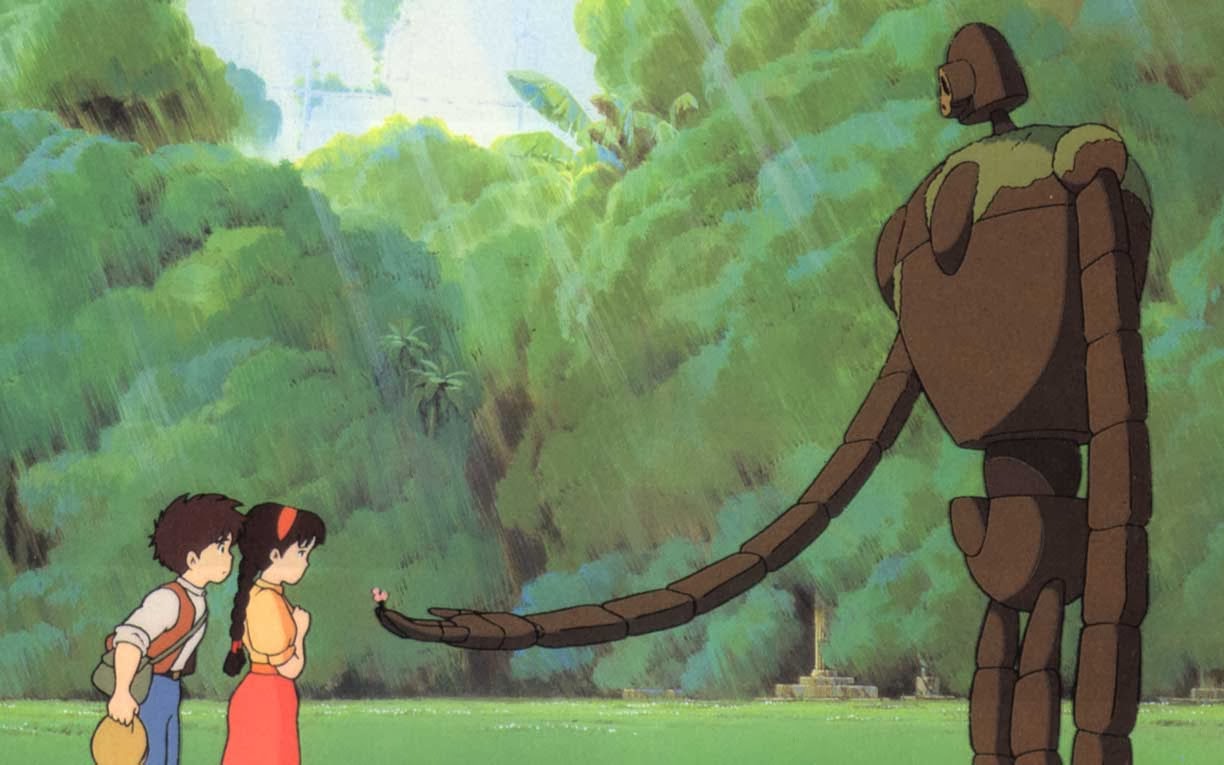
most memorable Studio Ghibli has ever produced. I especially love the giant
stone robots which seemed to be pulled straight from the Max Fleischer Superman
cartoons. They’re rather spectacular.
Castle in the Sky isn’t my favorite work of Miyazaki’s but
it still stands head and shoulders above other animated features as an imaginative
and immensely entertaining piece of work.
To celebrate the release of legendary filmmaker Hayao Miyazaki's
final film The Wind Rises this weekend, I will be writing reviews for
all of his films. (With the exception of Lupin the Third: The Castle of
Cagliostro, which I unfortunately do not have access to) I will try to
release at least one or two per day in the days leading up to the film's
release on Friday, February 28th. I hope you enjoy!
Despite the fact that it is preceded by The Castle of
Cagliostro, the general consensus labels Nausicaa of the Valley of the Wind as
Hayao Miyazaki’s first ‘official’ feature. (Probably because The Castle of
Cagliostro was an adaptation of a manga created by someone else) Many of the
characteristics that would become staples of his later films are already on
display here. You’ve got a strong female protagonist, a commentary on the
importance of living in harmony with nature, fantastical flying machines, etc.
And while Nausicaa shows Miyazaki still finding his way as a storyteller, it is
still a successful and highly enjoyable effort.
It’s been a thousand years since the catastrophic event known
as the Seven Days of Fire wiped out all life on earth, leaving a vast Toxic
Jungle in its wake. Poisonous spores in the Toxic Jungle make human life
without the assistance of breathing apparatuses impossible, but there are
settlements established in which human beings can live free of these spores.
Nausicaa is the princess of one such settlement – The Valley of the Wind. She spends much of
her time researching the Toxic Jungle in the hopes of finding a cure for the
poisons that threaten humanity. She also has a rare ability to commune with the
strange creatures of the forest, including a species known as Ohm. (Think of
ginormous roly-poly’s with dozens upon dozens of glowing blue orbs/eyes on
their bodies) Despite her attempts to convince her people to live in harmony
with the jungle, many feel it would be a better course of action to destroy it
entirely and rid the world of the poisonous spores and creatures that inhabit
it. Things take a turn for the worse when Nausicaa becomes involved in a plot
to revive one of the powerful beings that brought about the Seven Days of Fire.
It becomes clear that she alone holds the key to stopping this plan and saving
not just her own people but the creatures of the Jungle as well.
Nausicaa of the Valley of the Wind’s animation isn't as polished as Miyazaki's later features, which isn’t much of a surprise considering it was made in the
early 80’s when Japanese animation was still finding its way. Despite this, it
still carries that transcendent Miyazaki style, which he would continue to
develop over the years. Even this early on in his career his imagination fires
on all cylinders; his designs are so spectacular and unique. The Ohm in
particular are fascinating creatures and I loved the different airship/flying
machine designs. Miyazaki’s outspoken view on the destructive nature of mankind
and our ability to overcome it is on full display here and would end up
appearing in practically every other film he made during his illustrious
career. Although the characters in Nausicaa aren’t quite as sophisticated as
the characters in Miyazaki’s later works and the storyline is a bit simplistic,
it is still a superb piece of animated cinema and well worth a look for any fan
of Miyazaki or animation in general.
I’ll cut right to the chase: I loved The Lego Movie. It’s
wonderful in every sense of the word. We’re only two months into 2014 and
already we have a front runner for one of the best pictures of the year. I’d
even go so far as to say that if I were to compile a list of my top ten
animated features of the past ten years, The Lego Movie has a very strong
chance of ranking near the top. It’s charming, intelligent, inventive,
consistently hilarious and, to top it all off, it’s got a great deal of heart. In
other words, it’s everything I’d ever want from a movie going experience and I
couldn’t be happier it found its way to the big screen.
Its main story follows a construction worker named Emmet who
lives in a totally rigid society. (And not just because everything is made of
building blocks) Everyone follows pre-established rules and guidelines which
dictate exactly how they should be living their lives. No one dares stray from
them because, well, why would you? One fateful day, Emmet stumbles upon a magic
block called the Piece of Resistance, which fuses itself to his body. It turns
out this device is the only thing that can stop the dastardly ruler President
Business from destroying all Lego life as we know it and it’s up to Emmet and a
small band of heroes to save the day!
From start to finish, The Lego Movie seems like the kind of
unhinged fever dream that only a ten-year-old could dream up. If this sounds
like a backhanded comment, it’s certainly not intended as such; this is what
happens when brilliant imaginations are unleashed, freed from any restraints or
insecurities that might hinder them. And the imaginations of writers Dan
Hageman, Kevin Hageman, Phil Lord and Christopher Miller truly are brilliant in
every possible sense of the word. They have crafted a remarkable screenplay
that captures the essence of what makes these little building blocks so very special.
Their script is refreshingly intelligent too. It’s packed with great humor,
great characters and even a thoughtful social commentary. Sometimes they get a
bit carried away in their fast-paced zaniness, but for the most part it all
works splendidly.
The animation here is quite a sight to behold. It appears to
be a seamless combination of computer generated techniques and stop-motion
animation, which makes for a unique aesthetic that’s quite unlike anything I’ve
seen before. It makes for some rather exciting action sequences that blow away
practically everything I saw in any action movie released last year.
The voice casting is sheer perfection as well with the likes
of Chris Pratt, Elizabeth Banks, Morgan Freeman, Charlie Day and Will Ferrell,
amongst others, filling in the ranks. It’s quite a knockout ensemble and each actor
instills their characters with immense amounts of charm. Additionally, whoever
decided to cast Will Arnett as Batman should be given a large medal and a solid
handshake/pat on the back; I’d pay good money to see Arnett take on the Bat-Mantle
any day of the week.
CONSENSUS: The Lego Movie is a colorful, imaginative roller
coaster ride of non-stop fun and excitement. It hits all the perfect beats of
family-friendly entertainment while offering more layers than your standard
kiddie-fare. (And even some standard adult-fare, for that matter) Its zany
antics are occasionally exhausting but its immense levels of charm keep the
picture soaring. We may still have plenty of movies to go this year, but I
sincerely doubt many of them will reach this level of excellence. FINAL RATING: 4.5/5
And here it is, as promised, my personal ranking of the Beatles albums. I hope you enjoy!!
13. YELLOW SUBMARINE (1969):
Okay, it's standard procedure to include this in the pantheon of Beatles records, but everyone knows it doesn't really count. After all, it only included three or four new compositions from the boys who were far too busy working on their self-titled release to be bothered. Half of the tracks on the first half are pulled from previous releases and the second half is George Martin's score for the animated film. Considering all this, it should come as no surprise that it's my least favorite of the Beatles' albums. I think I've listened to it all the way through once in my entire life and I have no strong desire to revisit it any time soon.
12. LET IT BE (1970):
On which the Beatles finally proved they were just as fallible as anyone else. Let It Be has a few lasting classics, but for the most part the album functions mostly as a reflection of the troubled times that spawned it. The Beatles were completely exhausted and fed up with each other and you can almost feel the tension in the room when you listen to the album. Though it was officially released in 1970 as their 'final' album, it was recorded between The Beatles (White Album) and Abbey Road. Paul was the one who came up with the concept behind Let It Be: The Beatles were going to get back to their roots, forgoing all the studio experimentation that had made them studio innovators with more focus on performing together as a single unit again. The project, originally titled Get Back, would be recorded live as they performed the album from beginning to end. Simultaneously, a documentary film crew would capture their journey from conceptualization to implementation, climaxing with the planned triumph of their live show.
Sadly, the idea was doomed from the start due to the already high tensions between the four band members and it ended being the final straw that broke the camel's back. Instead of documenting the Beatles succeeding in every one of their creative endeavors, the film Let It Be and its album ended up showing the process of a band's break up. The recording atmosphere was extremely tense and uncomfortable for everyone involved, a miserable time for all. The band abandoned the project and it wouldn't see the light of day until it was released in 1970 after their triumphant finale Abbey Road.
Even in their darkest hour, though, the Beatles managed to craft some true gems such as 'Get Back,' 'The Long and Winding Road,' 'Across the Universe' and the title track. Unfortunately, Phil Spector's production on certain tracks is overwrought and obnoxious, ignoring the sparse arrangements McCartney had originally envisioned for the project. Spector fills the empty spaces on 'The Long and Winding Road,' 'Across the Universe' and 'Let It Be' with overtly sentimental orchestral arrangements that dilute the final products tremendously.
Years later, McCartney would oversee the production of 'Let It Be...Naked,' a vastly superior effort that forgoes the use of Spector's bombastic 'Wall of Sound' production for the sparser arrangements that the original recordings had been striving for. The sequencing of the tracks is a huge improvement as well and the inclusion of 'Don't Let Me Down,' one of the finest songs the Beatles ever made adds a missing piece that makes the overall picture all the more satisfying.
11. BEATLES FOR SALE (1964):
Both Beatles for Sale and Let It Be were recorded under similar circumstances: They both find the Beatles at a point of physical and emotional exhaustion. But while Let It Be was the result of a band who was fed up being together, Beatles for Sale finds the Fab Four exhausted by external forces and a grueling schedule comprised of non-stop touring, music recording, television appearances, screaming fans and, just to balance everything out, starring in a feature film. Needless to say, the Beatles were beginning to feel the strain of fame and after the huge creative output that resulted in one of their best records to this point in their career (A Hard Day's Night), it's no surprise that they stumbled a bit with this follow up.
Now, I don't mean to make it sound as if Beatles for Sale is a bad album; a 'bad' Beatles album is still better than the majority of the crap being released under the guise of music these days. It's just a bit disappointing compared to its predecessors. That being said, Beatles for Sale is fascinating simply because it shows a major shift in the songwriting stylings of John Lennon and Paul McCartney. Instead of upbeat compositions such as 'Can't Buy Me Love' and 'I Wanna Hold Your Hand,' we've got songs like 'I'm a Loser' and 'Baby's in Black.' If you couldn't figure it out from the song titles, these tunes take on a more negative, pessimistic tone than anything the band had previously recorded. Just take a looksee at the lyrics of 'I'm a Loser':
Although I laugh and I act like a clown Beneath this mask I am wearing a frown My tears are falling like rain from the sky Is it for her or myself that I cry?
CHORUS: I'm a loser And I lost someone who's near to me I'm a loser And I'm not what I appear to be
Not exactly 'She loves you, yeah, yeah, yeah!' is it? Lennon cites Bob Dylan as a major influence on this period in his songwriting and you can definitely pick up on that. The first three songs on the album: 'No Reply,' 'I'm a Loser' and 'Baby's in Black' take on a folky, morose tone the likes of which the Beatles hadn't really exhibited before. Following this Self-Pity Trilogy is their cover of Chuck Berry's 'Rock and Roll Music,' which gives the impression that they were still a bit uncomfortable with the more introspective songwriting that would shape their later works and felt the need to retreat back to their more upbeat repertoire.
The rest of the album, most of which consists of rockin' covers, takes on this more upbeat vibe. 'Kansas City (Hey Hey Hey)' is definitely the highlight here, as is Lennon's composition 'Eight Days a Week.' Lennon was never a big fan of the song and sure its lyrics are nothing to write home about, but it's catchy and irresistible. Strangely enough, Lennon is a bigger fan of his cover of 'Mr. Moonlight,' which many Beatles fans find to be one of the worst songs the Beatles ever recorded. (It's really not that bad. At all) The remaining songs on the album aren't particularly spectacular, but solid overall, making Beatles for Sale one of the more uneven efforts in the Beatles' catalogue.
10. WITH THE BEATLES (1963):
Very little can top the Beatles' debut album Please Please me as far as pure energy goes, but the boys decided to give it their best show anyway with their follow-up record With the Beatles. (Released only eight months after their debut) Its opening track 'It Won't Be Long' kicks things off in grand fashion. The songwriting of Lennon and McCartney was coming along nicely at this point as proven by the likes of 'All I've Got to Do,' 'All My Loving,' 'Hold Me Tight' and 'I Wanna Be Your Man.' Even Harrison got a chance to show off his blossoming skills with his first songwriting effort to be featured on a Beatles album 'Don't Bother Me.' Their covers are top-notch as well, with the standout being McCartney's take on Meredith Wilson's 'Till There Was You.' Other covers such as 'Roll Over Beethoven' and 'You Really Got a Hold on Me' are pretty good too, but don't quite match up with the original compositions of Lennon/McCartney on display.
When you put it up against its predecessor Please Please Me, With the Beatles doesn't quite match up song for song; the energy levels just aren't as consistent. But it's a more than worthy follow up and a strong indication that John, Paul, George and Ringo had a very promising career ahead of them.
9. PLEASE PLEASE ME (1963)
'One, two, three, FAH!!!' So begins one of the best opening tracks of what could arguably the best debut album of all time. And just try to NOT tap your feet as you listen to 'I Saw Her Standing There,' I dare you! Okay, if you really tried, you could do it, but you'd have to put forth a whole lot of effort.
Recorded in a single 12-hour session, Please Please Me is non-stop fun from this total blast of an opening to its spectacular, rip-roaring closer 'Twist & Shout.' Sandwiched between these two tracks are some of the most energetic and carefree tunes the Beatles ever recorded. What's really impressive is that even at this early stage in their careers, Lennon and McCartney were already churning out original songs left and right. Songs like 'Ask Me Why,' 'Please Please Me' and 'Love Me Do' are not only supremely catch, they showcase the advent of the duo's abilities to craft impeccable pop songs. This was a time when not many bands were writing their own material, so the fact that the Beatles were writing songs that could hold their own with the most popular tunes of the day and age is pretty impressive. Their covers of songs like 'Misery,' 'Anna (Go to Him),' 'Chains' and 'Boys' are also excellent and give a great indication of just how tight the boys were as a band. Very few albums are this consistently enjoyable.
8. A HARD DAY'S NIGHT (1964):
A Hard Day's Night was the second Beatles album I listened to after being totally blown away by Rubber Soul and it cemented my obsession with the band once and for all. It was the first album the Beatles released that featured all original songs coined by Lennon/McCartney and they're all fantastic, showcasing the blossoming talents of the songwriting duo.This album and the classic film that accompanied it have come to represent the epitome of Beatlemania and both flawlessly encompass all the things that made the Beatles so amazing at this early stage in their careers: Great haircuts, great style, great humor and, above all, great songs. In fact, the music here bests everything they'd done on their first two albums Please Please Me and With the Beatles.
The first half of the album, comprised of songs which actually appear in the film, is perfection. 'I Should've Known Better,' 'If I Fell in Love with You,' 'I'm Happy Just to Dance with You,' 'Can't Buy Me Love' - These are all instant classics. The second half is a bit slower paced and the songs aren't quite as memorable, but they're still fun. If you're looking for a good entry point to start exploring this amazing band, you'd be hard-pressed to do much better than this one.
7. HELP! (1965):
A Hard Day's Night may be the better movie, but I'm of the opinion that the soundtrack for the Beatles' second movie Help! is slightly superior to its predecessor. The movie itself is a bit too madcap for my liking, which isn't much of a surprise considering the Beatles were stoned out of their minds for the majority of the film shoot. It makes for a rather incoherent viewing experience, but its soundtrack shows the band in fine musical form.
The title track is a superb piece of work and a genuine cry for help from Lennon disguised as another one of the band's upbeat pop tunes. Dylan's influence continues to show itself with outstanding tracks such as Lennon's 'You've Got to Hide Your Love Away.' 'I Need You' and 'Ticket to Ride' are also superb, but it's McCartney's work that may take the cake here, especially the back-to-back triumphs of 'I've Just Seen a Face' and 'Yesterday.' 'I've Just Seen a Face' perfectly captures the feeling of elation that comes with love at first sight; it's one of the most joyous love songs ever written. 'Yesterday,' on the other hand, focuses on the bitter end of a love and features Paul strumming away on an acoustic guitar, a major departure from the band's more rockin' stylings and a major indication of the new musical directions they were exploring.
Not every track on Help! is as successful as the ones listed above, though. The first few tracks on the second half of the album ('It's Only Love,' 'You Like Me Too Much' and 'Tell Me What You See') are a bit lazy both lyrically and musically. It's as if Paul and John were still biding their time before delving into the more serious songwriting that would show up on their next album Rubber Soul.
Despite these slight misfires, Help! is yet another excellent effort from the group and the bridge between their more innocent lovey-dovey tunes and the innovative masterpieces that would follow.
6. MAGICAL MYSTERY TOUR (1967):
Like A Hard Day's Night, Help! and Yellow Submarine, Magical Mystery Tour is the soundtrack to a film of the same name. Unlike those films though, Magical Mystery Tour is much more experimental with occasionally fascinating, but mostly awful results. The soundtrack album however is yet another knockout effort from the band.
It's a bit more scattershot and less coherent than Sgt. Pepper's and a lot of this is due to the fact that most of the songs which make up the second half of the album were previously released as singles and not intended to be part of a 'larger picture.' Despite this, the songs are so amazing that they more than make up for the overall lack of cohesion. You've got underrated masterpieces like 'The Fool on the Hill' and 'Your Mother Should Know' paired up with undisputed masterworks such as 'I Am the Walrus,' 'Hello Goodbye,' 'Strawberry Fields Forever' and 'All You Need is Love.' (The last of which was recorded during a live broadcast in a single take. Pretty impressive, if I do say so myself) There are also a couple of really bizarre tunes like 'Flying' and 'Blue Jay Way,' which are quite unlike anything else the Beatles ever recorded. Harrison's 'Blue Jay Way' is particularly fascinating and quite possibly the creepiest song the Beatles ever made this side of 'Revolution 9.'
Lennon has cited Magical Mystery Tour as his personal favorite of the Beatles' discography for being so weird and to this day it continues to maintain its reputation as the Beatles' trippiest album.
5. ABBEY ROAD (1969)
Even though it was released prior to Let It Be, Abbey Road was actually the last time the Beatles ever recorded together as a band and it is everything that Let It Be isn't: Inspired, energetic and unbelievably brilliant from start to finish. The fact that the Beatles managed to record an album this amazing after recording its underwhelming predecessor is nothing short of a small miracle. That it includes some of the best songs the band ever recorded in their entire career is an even bigger one. From its opening track, the revolution-prompting 'Come Together' to Harrison's masterpieces 'Something' and 'Here Comes the Sun' all the way to the stunning medley that closes out the album and the entire Beatles legend, everything here is sheer perfection as only the Beatles could produce.
Feeling that this would indeed be the last time they worked together as a group, John, Paul, George and Ringo left their egos at the door and did their utmost to ensure their final effort would be a winner. It emerges as one of their most spectacular efforts and it is arguably the best album they ever produced. No other band on this good, green earth can lay claim to such an outstanding swan song.
4. THE BEATLES (WHITE ALBUM) (1968):
The Beatles (White Album) is a massive, sprawling epic, oft imitated but never matched. Compared to the clean, concise sequencing of its predecessors Sgt. Pepper's Lonely Hearts Club Band and Magical Mystery Tour, it's something of a garbled mess. It's a bit ironic considering both Sgt. Pepper's and Magical Mystery Tour's album covers are packed to the brim with color and creativity and this album's cover is totally blank because its contents may be even more sporadic and creative than those two albums combined.
At this point in the lifespan of the Beatles, the band members were each spiraling into their own artistic directions, directions which would frequently crash with one another's. Ringo got so fed up at one point, he quit the band for a short period of time. (Paul actually plays drums on 'Back in the USSR' and 'Dear Prudence,' two of the album's best tracks) Nearly every song on this double album was more of a solo effort than a collaborative one and it contributes to the overall lack of cohesion. But the messiness is part of what makes this album so bloody brilliant. It's expansive and raw, featuring multiple genres no matter how goofy they might be. Every single idea was thrown against the wall and even the ones that didn't stick were shoved onto the album anyway. Even the more baffling tracks like 'Glass Onion,' 'Wild Honey Pie,' 'Piggies,' 'Why Don't We Do It in the Road?' and the infamous 'Revolution 9' (Amongst others) are integral pieces of the puzzle.
Although there are a number of indisputable masterworks on the album, ('While My Guitar Gently Weeps,' 'Happiness is a Warm Gun,' 'Helter Skelter,' etc.) I find my favor leaning towards the lesser-known works such as 'Martha My Dear,' 'Rocky Raccoon,' 'I Will,' 'Julia,' 'Honey Pie,' 'Cry Baby Cry' and the album closer 'Good Night.' There's something really beautiful about the simplicity of these songs and their modest, charming natures.
To this day, The Beatles (White Album) has a tendency to split the band's fanbase down the middle, but there can be no question as to its status as yet another integral masterpiece in the band's discography.
3. SGT. PEPPER'S LONELY HEARTS CLUB BAND (1967):
Sgt. Pepper's Lonely Hearts Club Band is, to put it in cinematic terms, the Citizen Kane of rock albums. It blew the doors wide open on what the limits and expectations of a popular album could be and completely changed the way music was made forever and ever, amen. Prior to its release, 'serious' music aficionados didn't pay the slightest bit of attention to rock music. Sgt. Pepper's singlehandedly proved the genre could be taken seriously as an artform. You'll find it near the top of every 'Greatest Albums of All Time' list and for good reason: From the album artwork to the sequencing of the songs, everything about it is revelatory.
Nothing can quite match up to the opening one-two punch of the opening tracks 'Sgt. Pepper's Lonely Hearts Club Band' and 'With a Little Help from My Friends.' 'Getting Better,' 'Fixing a Hole,' 'She's Leaving Home' and 'Lovely Rita' are other highlights. Then, to top everything off, the album closes with what is arguably the very best Beatles song: 'A Day in the Life.' If you haven't heard it, I strongly suggest you do so immediately; it represents the peak of the Beatles' creativity and contains some of the best writing John and Paul ever did together.
It's funny, though; despite its status as a bonafide masterpiece, John, George and Ringo weren't the biggest fans of the record. Harrison and Starr in particular felt a bit on the sidelines during its production due to the fact that it was more of a studio-focused effort as opposed to their 'live performance' works in the past. Starr was quoted as saying he had so much free time during its recording, he learned how to play chess.
Many folks these days seem to take great pleasure in labeling Sgt. Pepper's Lonely Hearts Club Band as an overrated effort; anything that's labeled as 'the greatest' in any category opens itself up to undue criticism. But, at the end of the day, it's pretty much impossible to overstate its contribution to music. So many common practices in regards to making music these days were instigated by Sgt. Pepper's. And while I'd argue that the Beatles made better albums, almost nothing comes close to the level of pure, unhinged creativity that Sgt. Pepper's represents. Its status continues to stand undiminished and will do so for many, many years to come.
2. REVOLVER (1966):
George Harrison stated once that the recordings for Rubber Soul and Revolver were so intermingled he felt that Revolver was just Volume 2 to Rubber Soul's Volume 1. Listening to Revolver, it's not terribly difficult to understand his outlook. Both albums represent huge creative strides for the Beatles, both lyrically and musically. As on its predecessor, Revolver sees the band taking big steps in terms of lyrical content, but there's also a stronger focus on musical innovation this time around.
That's not to say the songwriting take a backseat to the techniques though; there are some amazing songs here, from McCartney in particular. 'Eleanor Rigby,' 'Here, There and Everywhere' and 'For No One are easily some of the very best songs ever recorded and in them McCartney finally fulfills the promise he showed with his low-key masterpiece 'Yesterday.' Not all of his contributions are of the morose variety though. 'Good Day Sunshine' and 'Got To Get You Into My Life' are two of the most upbeat songs the Beatles ever recorded.
Lennon's efforts here are less memorable than McCartney's with the exception of 'I'm Only Sleeping' and Revolver's final revolutionary track 'Tomorrow Never Knows.' The latter song, at only 3 minutes long, contains more ideas and innovations than most full albums. It's even more stunning that something that groundbreaking was created in 1966 when the technology available in a recording studio was so primitive. Harrison also makes a big breakthrough in his songwriting with 'Taxman,' a song so great that even Lennon and McCartney agreed it should be the one to kick off the album. 'Love You To' is another fascinating work, which showcases Harrison's new found interest in Indian music and his expanding musical horizons.
The final result is yet another perfect album and in the running for the very best ever made - Further evidence that the Beatles' genius knew no bounds.
1. RUBBER SOUL (1965):
"We come to it at last. The great album of our time..."
This is it. This is the one that singlehandedly turned me into a massive Beatles fan and started me down the path of listening to music in a whole new way. At this point in the band's career, the Beatles had made a definitive switch from focusing on more simplistic songwriting and had begun delving into more complex material.
The Fab Four were heavily influenced by Bob Dylan and marijuana. As evidenced by the music on this album, this is clearly a winning combination. There's a lot more focus on acoustic-driven numbers and the jangling guitars that gave the Byrds their unique sound. (A sound which was evidently inspired by George Harrison's work on A Hard Day's Night) The biggest acoustic standout is 'Norwegian Wood,' which is my favorite Beatles song and one of Lennon's finest compositions. Lennon made some major strides with this record. His work on 'Nowhere Man' and 'In My Life' is truly extraordinary. 'In My Life' invokes the pain of growing older and saying farewell to friends/events of the past in splendid fashion. On the flipside of things, 'Nowhere Man' discovers the same character attempting to find himself in the wake of being a 'grown up' and not having much luck. Another Lennon masterpiece 'Girl' finds his love song writing abilities still intact but with a more mature, pessimistic outlook that would become a staple of his later efforts.
McCartney is still primarily focused on simpler love songs such as 'You Won't See Me,' 'Michelle' and my personal favorite 'I'm Looking Through You.' His contributions offer the perfect counter-balance to Lennon's more introspective work here, further emphasizing the duo's status as the perfect Yin/Yang of songwriting. Harrison throws a couple of good ones into the mix as well with 'Think for Yourself' and 'If I Needed Someone.' Of the two, the former comes the closest to the brilliance of the Lennon/McCartney tunes here.
Everything gels flawlessly to make Rubber Soul one of the single greatest albums of all time and arguably the best in the Beatles catalogue. Not a single song is out of place; it's literally perfect. And before you judge me for using two of the most hackneyed and abused words in the English language, just know that in this particular case, their uses are totally justified.
So there you have it, ladies and gentlemen!! I hope you enjoyed my ramblings. Have a wonderful day!!


 9. THE WIND RISES – Hayao
Miyazaki’s swan song is more thematically subdued than his other works, but
just as visually stunning. It is a fitting finale for the career of the world’s
greatest living animator.
9. THE WIND RISES – Hayao
Miyazaki’s swan song is more thematically subdued than his other works, but
just as visually stunning. It is a fitting finale for the career of the world’s
greatest living animator.