Chances are if you’ve seen any of Steven Spielberg’s last few films
then you’ve seen Janusz Kaminski’s work. He’s the Academy Award winning
Director of Photography for films like “Schindler’s List” and “The Diving Bell & The Butterfly.”
He’s fantastically talented and has produced a lot of inspired work
over the years. More than likely you’ve got a great big boner for his
work and think he’s just about the greatest thing to come along since Mumford & Sons and Urban Outfitters.
I genuinely hate to rain on anybody’s boner parade but I’d like to
prepare you for the fact that I’m about to step on your unwarranted
Kaminski boner with my steel toed word boots.
It starts with this simple fact. You don’t know shit about
cinematography. I’m sure there’s a moral highroad 3 miles back in a
nice, silent little hamlet where everyone drives a Toyota Prius and the
clergy even have a gay priest in one of their parishes and they would
all be mortified at the precocity of my aggressive statement but I
really don’t give a damn.
You think high contrast images with intense and improbable shadows
are the work of a God. You think midday sun that shines with a more
pigmented orange than an Oompa Loompa’s face is quite simply the most
inspired piece of lighting in the last 25 years. I hope you have some
napkins on hand if the man is bold enough to put a catch light in an
actors eyes so you can see the deep brooding blue of his expressionless
stare into oblivion, otherwise you’ve just spoiled that brand new pair
of faded bootcut denims for no good reason.
You have the aesthetic sensibilities of a raccoon pining for a piece
of shiny scrap tin at the bottom of a hollowed out log. Your visual
allegiance is dictated by the barometer of academy awards season and
you’ve all the artistic integrity of a pair of knock off thick frame
Alan Ginsberg glasses.
He finished “Diving Bell & The Butterfly” and thought, “Eh, time
for a break.” But the applause hasn’t stopped. What people are cheering
for is the work of an over-funded, under-motivated, bored yet still
talented director of photography.
“It was gorgeous.”
“It was beautiful.”
“It was amazing.”
These adjectives are certainly positive but are they the appropriate
ones for the story that was attempting to be told? The fact is that
pretty pictures aren’t so difficult to create, but the appropriate
images for the story and the proper visual language to set the necessary
tones are. That’s something he hasn’t shown an ounce of interest in
since 2007. The last time he gave a damn was a half-decade ago when
people were just beginning to realize that Coldplay was the
greatest thing ever. Now it’s 2012 and he’s shown absolutely no
progression or interest in progression since then and people are finally
realizing that Coldplay sucks.
Munich wasn’t bad. Munich was pretty much par for
the course and certainly showcased his vast expertise yet all of his
films since have shared very similar visual motifs. High contrast film
stocks with slightly overexposed negative that are then pulled down in
processing to reduce grain then accented with DEEP shadows and smoke
filled rooms and tangible shafts of light. His camera movement, when he
works with Spielberg, is all dictated by Spielberg himself, beyond that
it’s standard fare…..maybe even a bit below standard because they have
been comedies; I can’t think of an easier way to collect a paycheck.
Now with Lincoln set to come out mid-November it appears as though he
hasn’t deviated from this course in the least little bit. Are the
images bad? Certainly not, they are quite pretty from what the trailer
indicates. It is, of course, just a trailer so it’s impossible to tell
if he’s reckoned on the right tone or overall aesthetic for the film but
a few things are almost certain. People will love it and praise it and
make guttural noises when people mention it’s name, and it will get an
Academy Award nomination.
The same argument could be made for most other departments.
Especially production design and costume design. Victorian films should
always win because of how giant and beautiful and wonderful and
intricate and detailed and rich and authentic and inspired and gorgeous
and labor intensive they are by most peoples standards.
What is luxurious and excessive is not always appropriate. In America
that doesn’t really concern us though. We have no concept of
perspective and propriety with regard to supplemental material and
departments in support of story. If any one element of the film speaks
louder than the story itself then it has failed.
But nobody seems to get that.
We just like pretty pictures that evoke surface emotions. We want the
instant gratification that comes from being able to immediately
identify something that looks good and to be able to feel the small, yet
forgettable tingle that a pleasing picture has in the core of our
stomachs. We can’t sit and wait and look for something more than that.
And therein lies the appeal of Janusz Kaminski’s most recent work. It’s
an episode of How I Met Your Mother, or a passage from a Tom Clancy novel. You don’t have to know anything to enjoy it……….and that’s exactly why you do.
Wednesday, September 26, 2012

The Master Review!
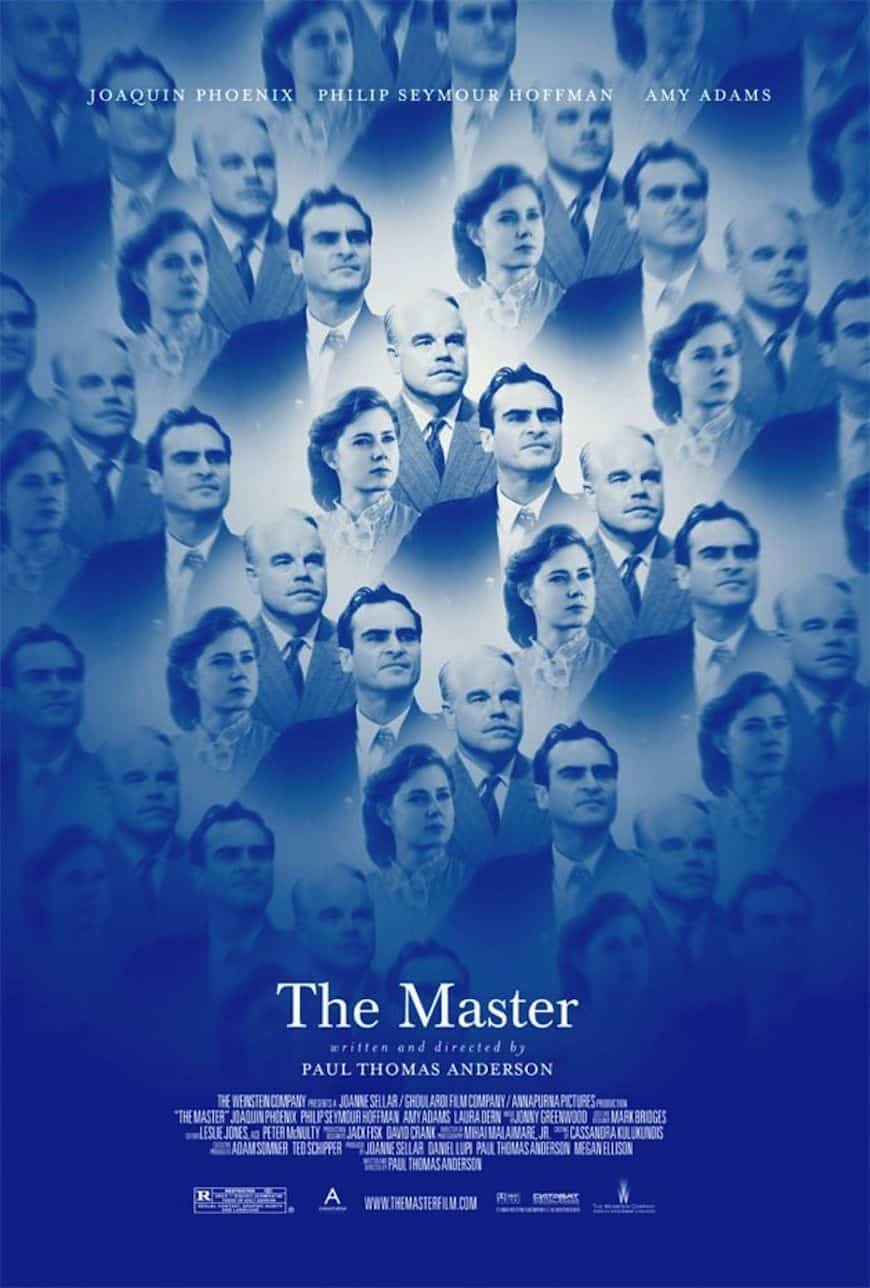
One enters into the world of Paul Thomas Anderson's imagination with the expectation of visual splendor and deeply thoughtful, albeit occasionally disturbed storylines. Over the years, he has proven a knack for taking on ambitious projects involving the nature of humanity and its struggles in powerful morality tales. He is a filmmaker in the purest sense. Now, two years after his potential masterpiece There Will Be Blood, P. T. Anderson presents us with the lengthy, ambitious, and somewhat frustrating doozy of a film The Master.
The Master has a simple story to tell, but the method of its telling is anything but simple. Joaquin Phoenix plays Freddie Quell, a veteran of WWII who is finding it difficult to adjust to the post-war world. He is prone to violence, heavy bouts of drinking, and has an unhealthy obsession with sex. He's a rather despicable character, indeed, but, as portrayed by Phoenix, he is also strangely sympathetic. After a bit of aimless wandering and violent shenanigans, Quell happens upon a cruise boat owned by none other than the prestigious entrepreneur Lancaster Dodd portrayed by the always fantastic Phillip Seymour Hoffman. Dodd is the founder of a mysterious movement simply known as The Cause. Through a procedure known as 'processing,' his movement seeks to cure every individual of any/all ailments whether they be physical or mental. Quell is easily seduced by Dodd's charm and personality and Dodd is blown away by Quell's drink-making abilities. He recruits Quell to his movement and the plot trickles off into all kinds of different directions as Quell continues to serve as Dodd's primary guinea pig for all of The Cause's experiments.
The film carries itself with an air so replete with importance that it's not too difficult to be utterly captivated by the unfolding events. However, much like Lancaster Dodd himself, it makes many arguments for its cause without providing much substance for them. The performances and visuals are so astonishing, in fact, that they can easily distract one from the fact that there's not a whole lot going on here. Though he may deny it in interviews, it's very clear that Anderson is trying to say something about the Scientology movement, but what exactly that something is is a bit muddled. We are presented with numerous scenes and conversations that address the disturbed nature of The Cause, but we are never given enough information about the movement to formulate an opinion of our own. We feel disturbed by the nature of Dodd's character, but we don't get a sense of the extent of his madness or what is driving him to pursue this movement so passionately. Quell, as portrayed by Phoenix, is always fascinating to watch, but one never truly connects to him as a character and there appears to be no purpose to his journey in the film. When everything is said and done, it becomes quite apparent that not a whole lot was said and done.
Nevertheless, The Master is a fascinating, maddening filmgoing experience and should not go unnoticed. Both Phoenix and Hoffman are stunning and utterly captivating in every way possible and carry the film from beginning to end and Anderson has a mastery of his craft that puts practically all others to shame. Expect to be intrigued, but don't be too shocked if you find yourself unmoved by the proceedings.
FINAL RATING: 3.5/5
Monday, September 10, 2012
Beasts of the Southern Wild

The performances are decent enough. Quvenzhané Wallis as Hushpuppy is adorable and effective and Dwight Henry as her father Wink also gives a solid, energetic performance. Still, it's difficult to connect to either of their struggles when everything story/character-related seems to be going in so many different directions, none of which offer any satisfying conclusions. There just isn't nearly enough going on here to justify taking the journey. All it ends up amounting to is a semi-fascinating, semi-beautiful fever dream of a tale in which not much makes sense and not much of consequence happens.
Despite these flaws, however, Beasts of the Southern Wild is still worth seeing simply for its sheer ambition and its occasionally dazzling visual aesthetic. Just don't be surprised if you come away from the proceedings feeling rather indifferent about the whole thing.
FINAL RATING: 3/5
Monday, July 23, 2012
The Dark Knight Rises and My Dreams Come Crashing Down

***BUYER BEWARE: SPOILERS AWAIT YOU IN THE DEPTHS OF THIS RANTING, RAVING REVIEW OF THE DARK KNIGHT RISES***
Back in 2005, as the release of Christopher Nolan's Batman Begins was looming on the horizon, no one would have guessed that it would mark the start of one of the most profitable and critically acclaimed trilogies of all time. At the time, I was completely indifferent towards the character of Batman. Despite their popularity, Tim Burton's Batman flicks never did much for me. They always felt a bit too kooky; a bit too fascinated with the outlandish environments more so than telling an actual story or building any interesting characters. And, of course, Joel Schumacher's Batman travesties' reputations precede them, so I won't bother addressing those here. (Though I will mention that my least favorite of that initial four-film run is actually Burton's Batman Returns, which is obnoxiously ridiculous and just plain mean-spirited) I went into the midnight screening of Batman Begins with an open mind and little to no expectations. What I saw completely floored me. Here was a great film, passionately made, that told a superb story which focused more on developing its characters than fashioning mindblowing sets and special effects. (Though those were rather impressive too) Performances all around the board were spectacular with the likes of Christian Bale, Michael Caine, Gary Oldman, Morgan Freeman, and Liam Neeson grounding the proceedings with their impeccable talents. For the first time, I felt like I'd finally seen a genu-ine Batman movie and I discovered an affection for the character that I'd never had before. I delved into the great Batman stories such as Batman: Year One and The Dark Knight Returns and realized that it wasn't that I didn't like the character of Batman, but that his previous cinematic iterations were so poorly rendered that my reaction to them could only be that of indifference. I was eternally indebted to Mr. Nolan for helping me rediscover my love for the Caped Crusader.
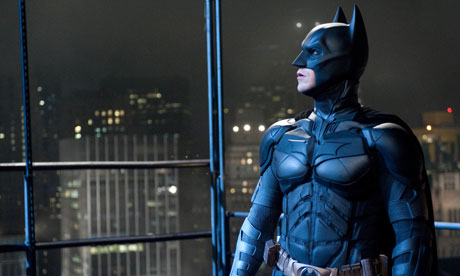
It is with the greatest of displeasure that I stand before you now (Actually, I'm sitting, but that's besides the point) to tell you that not only does The Dark Knight Rises fail to meet high expectations, but that, when all the dust from its less than rousing climax settles, it's sadly clear that it's just not a very good movie. At all. In fact, it's downright awful at times, and this is the last thing I ever wanted to have to say or admit about this film.
When watching any film, there is always a moment where I expect the story to win me over - either that or the characters or the action or the visuals - Whatever it may be, something about the film needs to grab my attention to give me a reason to stick with it 'til the end. About an hour and a half into The Dark Knight Rises not only did I not have that connection, but I found myself sitting in shock witnessing some of the most painfully contrived sequences of any film I'd ever seen hand in hand with painful dialogue and unmotivated character choices that were completely contrary to the source material as well as the world that Nolan had so carefully established in his first two Bat-Flicks.
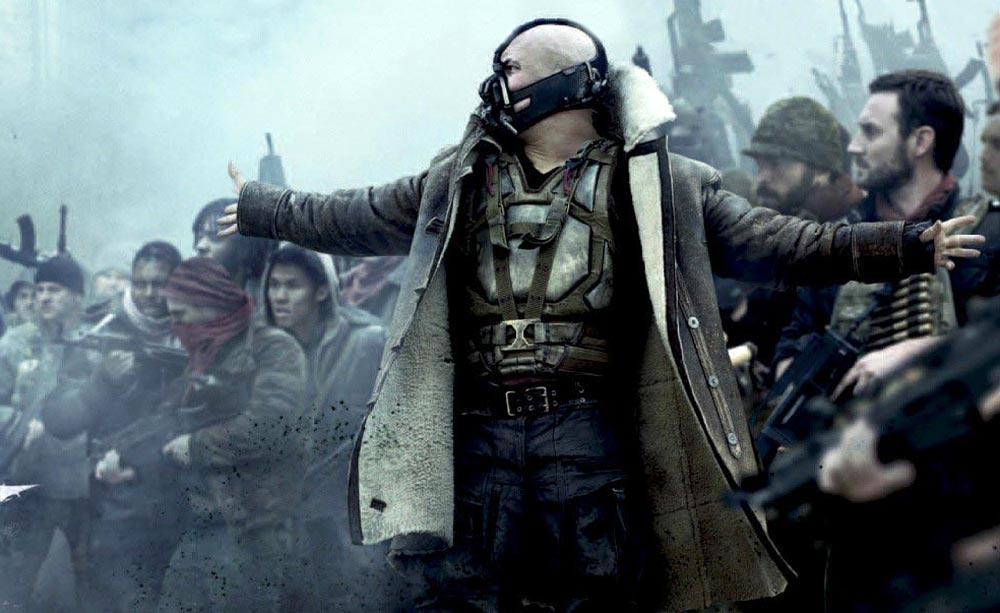
As the film goes on, logical character motivations and story choices collapse one by one in favor of a script that seems to serve no logical purpose but to jump from situation to situation - from locale to locale - with nary a connecting thread and no plot driving the events nor believable character development. In a plot move reminiscent of the beginning of Return of the Jedi, (Where the first 40 mins or so are spent wrapping up plotlines from the previous entry without actually moving the story forward) Bruce Wayne spends a large chunk of the film's running time completely separated from the main events of the story, having absolutely no effect on them whatsoever. Batman appears for a total of maybe 40 minutes in the whole two-hour and forty-five minute running time. Characters like Alfred and Lucius Fox, built up so well in the previous two films, are tossed aside for entirely superfluous reasons that feel nothing but phony. Michael Caine gives it his all and has a few genuinely moving moments, but is mostly absent from the proceedings here, opting to leave Bruce Wayne to his own devices in one of the movie's worst scenes. (Whatever happened to 'You still haven't given up on me?' 'Never.') Morgan Freeman's Lucius Fox also gets demoted to third-tier supporting character status, doing so little that one wonders why Nolan even bothered bringing him back. Even Gary Oldman's fantastic turn as Commissioner Gordon in the first two films gets completely shat on for this third outing. He's out of commission (Pun intended, now that I think about it) for half the film and when he finally gets the chance to do something, it's not much of anything. Is there anybody out there who can possibly explain to me how this can be considered good storytelling?

(As a side note, I'm not sure how he does it, but Nolan once again manages to fill the screen with some of the worst bit performances you will ever see in your entire life. Matthew Modine is the one that comes to the forefront of my mind, playing one of the most generic stereotypical cop characters you've already seen in a dozen action flicks)
I wish I could tell you that the action sequences make up for the illogical plot and lackluster character development, but even those are poorly executed, generic, and, perhaps worst of all for someone who has crafted three of the finest action films of all time, boring. It turns out that the 'epic' finale we were promised is nothing more than a series of uninspired fist fights and explosions. And, at the end of the day, what's Bane's grand scheme to destroy Gotham? A giant bomb. Yes, that's right. The genius, master director Christopher Nolan has resorted to a plotline that revolves around the most impersonal enemy a hero can ever face - Stopping a giant bomb from destroying a major city.
I hate everything.
Not a single action sequence carries a hint of inspiration. The only thing that comes close is a fight scene between Batman and Bane in the sewers beneath Gotham, but even that isn't quite as brutal as it should have been and you never quite feel Batman's struggle against the over-powering might of Bane. Nothing has any weight or consequence. Sure, Batman's back gets broken ala the classic Knightfall story from the comics, but, in what feels like a few weeks time, he's up and running again doing push-ups in the prison of standstill plotting. I'm not even sure if it was a few weeks, to be honest. The passage of time in this movie is so damn skewed that it's difficult to tell. Apparently by the time Batman returns to Gotham, five months have passed, but judging from the set decoration and the overall healthy state of the city's inhabitants, it might as well have been one or two days.
I take no delight in the disaster that is The Dark Knight Rises. I wanted it to be amazing and it had so much potential to be. It's stunning how horribly wrong every single facet of the film is. At the end of the day, the pointing finger of blame can only be directed at one man and that is Christopher Nolan. Easily one of the best filmmakers of our generation, Nolan has never disappointed me before, but this is just plain lazy filmmaking. The script is dreadful and half-baked, which I never would have expected from such a master director. I'm not sure what horrible turn of fate caused Nolan to believe that this would be the best way to end such a well-made trilogy of films, but one thing is clear, this is not only the worst of Nolan's Bat-Movies; it is, without a doubt, Nolan's worst film to date.

I never thought the Dark Knight's rising would end up being so flaccid.
FINAL RATING: 2.5/5
Thursday, July 5, 2012
With Great Power Comes Great Rebootability: The Amazing Spider-Man Review

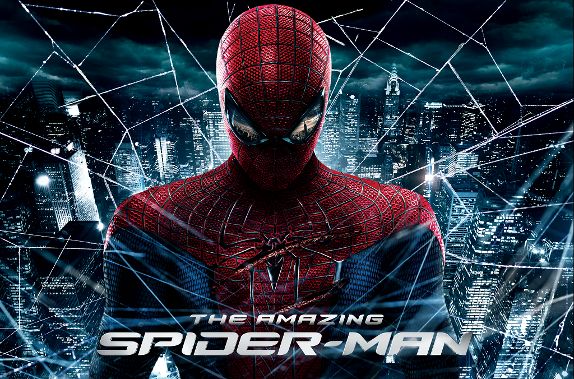
At its core, The Amazing Spider-Man has no particular reason to exist. When it came to Batman Begins, Casino Royale, or even the spectacular J.J. Abrams Star Trek, each respective franchise had found itself at the end of its creative rope in dire need of rejuvenation making the prospect of starting over a promising one. Not only that, but each one of these reboots managed to bring something fresh to the table story and character-wise, making each film an exhilarating take on well-worn legends: Batman Begins told the story of how Bruce Wayne came to don the cape and cowl; Casino Royale showed us a Bond who was more brutal and human as opposed to the invincible super spy that had grown stale over the years; Star Trek re-invigorated a stale franchise with its exciting take on the story of how the crew of the U.S.S. Enterprise came to be, while, even more impressively, honoring the canon of the Star Trek saga. The Amazing Spider-Man never gives us any reason why Spidey's origin needed to be retold and, as a result, retreading this territory makes the first hour or so feel remarkably blah. We find ourselves hitting every single story beat that has already been flawlessly presented to us in Raimi's film. (The infamous spider bite, discovering powers, using said powers to get back at school bully, Uncle's death, etc.) Even worse, completely misguided alterations to the classic origin story (What is, in this writer's humble opinion, the best superhero origin story out there) change the fundamental core of Spider-Man's character and why he does what he does. Now it appears he's just another brooding vigilante as opposed to a guilt-stricken young man who learns a powerful lesson about responsibility. Not only is this change painfully uninspired, but it threatens to turn everyone's favorite wall-crawler into another wannabe Dark Knight.
Sony, let's get one thing straight:
SPIDER-MAN IS NOT BATMAN.
I cannot stress this enough. Peter Parker is not driven by a desire for revenge. He is driven by the guilt he feels for playing a part in the murder of his Uncle Ben. His selfish inaction - Inaction which directly resulted in his uncle's untimely demise - drives him to be the hero that we all know and love. Spider-Man's motivation for what he does is not about vengeance; it's about penance. Instead of trying to take advantage of the success of Christopher Nolan's masterpiece, why not embrace the character of Spider-Man as he already is, because that story in and of itself is so rich with drama and inspiration that there's no need to foolishly mimic a franchise so removed from Spidey's core essence that trying to take a page from its book only goes to show how little you knew about his character in the first place. The changes made to Spidey's origin here ultimately hurt this story and this clear lack of inspiration plays a big part in why this film is not nearly as good as it could have been.
Phew, now that I've gotten that little rant out of the way, let's get back to business.
Despite these fundamental flaws, The Amazing Spider-Man is still quality summer entertainment and the main reason it cannot be dismissed entirely is due to one beautifully brilliant and gifted actor:
Stan Lee.
Just playin. (She needs a golden calculator to divide...) Though, his cameo here is probably his best yet.

But, like most elements of this reboot, Garfield finds himself the victim of a shallow screenplay. Parker doesn't have much of a character arc. At the film's start, he's a snarky, confident, wise-cracking nerd who gets the girl. By the film's end, he's a snarky, confident, wise-cracking nerd who gets the girl and has superpowers. There's practically no arc. Raimi's depiction of Peter Parker was spot-on. Peter is supposed to be shy, insecure, unpopular, and, most of all, unconfident. When he obtains his superpowers, it helps him discover his confidence and a sense of self-worth that he never had before. When Maguire's Parker discovers his powers, we feel his excitement because it's clear that this is a huge change for him. For Garfield, it just feels like another day in the life and it's not nearly as much fun watching him discover his abilities. Garfield's Parker is also able to get the girl without much work and it makes their relationship much less exciting to watch, regardless of the fact that Garfield and Stone have wonderful chemistry. I went into this film completely ready to embrace Garfield as the new Spidey, but, surprisingly, I found myself missing the genuine, all-around brilliance of Maguire's performance. Still, Garfield gives it his all and is a joy to watch. Here's to hoping that, come sequel time, the story will serve him better.
(And where the hell is J. Jonah Jameson??? I guess the producers realized that there was no possible way they could live up to J.K. Simmons' flawless performance in the Raimi trilogy, so they figured they'd buy themselves some time by not introducing him in this movie. His presence is sorely missed though)
Credit must also be given to Marc Webb. By the deft talent that is on display here, you would never guess that this is only his second full-length feature. He seems to have a mastery of the trade that, while still a bit shaky, only goes to show that, once his skills are a bit more fine-tuned, he will be a directing force to be reckoned with. His action sequences are fun, fast-paced, and thrilling in a way that Raimi's trilogy never quite managed to achieve. (Minus that phenomenal train sequence from Spider-Man 2) When Spidey finally gets to duke it out with the Lizard, the action seems to be pulled straight from the pages of the comics. The effects are also top-notch and the integration of reality vs. CG is mostly seamless and impressive. The Lizard looks a bit too much like the goombas from the Super Mario Bros. movie, but he's actually a bit more effective than I thought he'd be judging from production stills and the random snippets of clips that are floating around on the internet. Webb also injects a wealth of humor into the proceedings, that keeps the film light on its feet, even when it's trying too hard to live up to Nolan's Dark Knight trilogy.
The Amazing Spider-Man might not be necessary and it may not ever answer the question as to why we needed this series to be rebooted so soon, but, somehow, despite its flaws, it still works. The seeds are planted for what could be a really great new take on the beloved character and, if executed correctly, these future stories could more than make up for the lack of the originality on display here. One can only hope that the storytellers involved seek out their own identity instead of adopting other successful franchise identities as their own.
FINAL RATING: 3.5/5
Wednesday, June 20, 2012
Men In Black 3 - Underwhelmingly Entertaining

So, stop the presses, it turns out that Men in Black 3 is actually pretty good. Believe you me, I'm as shocked to be typing it as you are to be reading it, but it's true. Sure, it never reaches the heights of the original Men in Black, which still stands tall as one of the most entertaining pieces of modern cinema out there, but it's easily better than its vastly disappointing predecessor. That may not be much of a compliment when you really think about it, but let's not think about it too much, shall we? MIB3 has had its fair share of difficulties getting to the big screen, including the fact that it began production without a completed script. It seemed like every which way you turned, some silly movie blog was posting some form of unflattering news regarding its ill-fated production. So, the fact that it's actually not bad is a rather pleasant surprise!

The special effects also make their expected appearance and they look great - As does the creature design. The production design and effects teams should be commended. There are also some fun little action sequences here and there but they, like most of MIB3, feel underwhelming and slight. Still, the movie provides a solid two-hours of lighthearted, escapist entertainment and even wraps itself up rather nicely in a surprisingly touching way. Though you might not be kicking down the doors of Columbia/Sony demanding a MIB4, chances are if you go in with an open mind and low expectations, you'll find yourself pleasantly surprised by what's on display here.
Final Rating: 3.5/5
(If Will Smith had performed a song for the film, I might have kicked it up to an even 4, but I guess we'll have to just make do with 'NOD YA HEAD' from MIB2...)
Tuesday, June 12, 2012
Shawn & Shea Vs. Prometheus

Shea’s Thoughts:
The
very first word most people would use to describe Ridley Scott’s “Prometheus”
would probably be prequel. The year was 1979 and it was an exciting, if not
bizarre, year for movies with films like Star Trek: The Motion Picture, Apocalypse
Now, Manhattan, Mad Max, Caligula and The Life of Bryan all making their mark
in cinemas. It’s doubtful that Scott knew then that he was creating a cult
classic when he began shooting Alien the previous year, he probably couldn’t
have fathomed that he would be revisiting the same subject matter 33 years after the fact. But after
watching the new film for the first time it doesn’t feel very much like a
prequel. Certainly there are similarities and allusions to the original; even
interconnected plot points but whereas “Alien” was Jaws in Space, this is more
along the lines of a philosopher riffing absently on the toilet as he drags on
fat roach. But I don’t believe it’s fair to critique this movie as though it
were a prequel. It portends to stand on its own and thus it will be judged
solely on the merits of a standalone film, with or without the aids or
hindrances that come with being a prequel.
It’s
a fact that Ridley Scott is a master of filmmaking. He’s given us many gems in
his time and if there were one adjective that can be used to describe his
method of filmmaking, then I would choose “perfectionist.” Not many directors
have the opportunity to release cut after cut of their films long after the
original release date. Scott believes in getting it just right, even if that
means tinkering away for years after everyone else has been paid and moved on.
That gives me good reason to suspect we will see many directors cuts of this
film as well. More than that though it tells me that when he signed on to do
this film he wasn’t just interested in making more money or re-living his glory
days; he was genuinely interested in telling us a story that he thought was
important enough to dominate his time and talent. Thus we have “Prometheus.”

Prometheus
takes place in 2089 before the events of “Alien.” It follows the travels of
scientists Elizabeth Shaw (Rapace) and Charlie Holloway (Marshall-Green) as they
attempt to uncover the origins of mankind. Their discoveries take them to a planet
deep in space (2 years away in fact) where they hope to find their makers, and
here is where the mayhem ensues. Scott takes quick control of the helm and
guides the story patiently through its paces with great purpose and the
ever-unsettling undertone of the unknown. As a director he seems to thrive in
this atmosphere, collecting details seemingly at random but with such poise that
it’s almost magnetic. The eye is glued to the screen and he spares not a single
frame in the vast running time. “Prometheus”, then, is straight sci-fi; it
isn’t action or horror or thriller but pure science fiction without the long
inexhaustible dialogue that often takes place at a large council table. Here
also is the story's weakness, its writing.
Damon
Lindelof has no idea how to end a story. His series “Lost” ended with giant
disappointment for most of its viewers and the most notable things he’s
written before now has been “Cowboys and Aliens” and episodes of “Nash Bridges”
and “Crossing Jordan.” The thought
was that since he created “Lost” then he would be a perfect fit for the taut
and eerie tone that “Prometheus” was striving for. Instead he comes off looking
embarrassingly pseudo-intellectual by posing questions that he never intends to
answer himself. The film’s premise is wonderful and intriguing and involves the
audience almost immediately. He teases the mind with hints and what appear to
be clues as he drops crumbs of information while holding most of it back, but
ultimately it’s just a tease, in the end it feels like it was a half-baked
universe and the whole premise of the film suddenly feels like cardboard. It
seems that there is potent talent writhing just behind his inability to commit
to an idea. Some dialogue comes off as stilted and flat but not because the
cast is wooden or lacks talent. The conversations are minimalist and feel
largely inconsequential. The 3rd act is a cacophony of
disappointment and spoiled opportunities as giant question are sewn up with
commas and “To Be Continued’s” while the audience is punished instead of
rewarded for their patience.
It
seems like some of the plot points are unclear as well. Meredith
Vickers’ (Charlize Theron) sudden and random relation to Peter Weyland (Guy
Pearce) made all the impact of a wet rag hitting hot pavement. Even if that is
supposed to mean something more in an undeclared sequel then why not wait and
reveal it then when it matters more to the audience? As it stands now it just
appears to be some lame attempt to create a Shyamlyan twist late in the film.
It also seems unclear to me why David seems to want to destroy Shaw and
Holloway and why it’s such a necessity to hide Weyland all that time. Shaw and
Holloway want to find their makers and so does Weyland. He gave them the money
to do it so why would they have a problem with him being on board if he funded
their trip and wants the exact same thing that they do? Killing them does
nothing for his goal, in fact it hinders it since they are the most qualified
to help him achieve it. The logic seems false and poorly thought out if that is
the case. A film that asks you to pay close attention should gird the loins of it's plot points with more than lame dialogue and unmotivated actions.
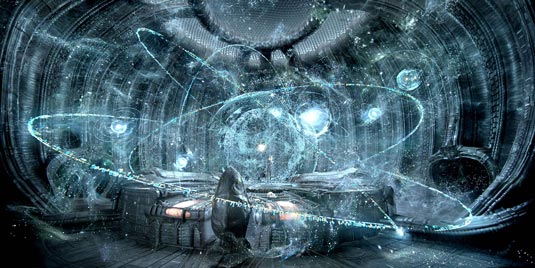
The
films saving grace is its visual deftness and the guiding hand of Ridley
Scott. The cinematography by Darisuz Wolski (Pirates of the Carribean, Sweeney
Todd) is celibate and restrained and entirely unobtrusive, which is remarkable
because the tendency with sci-fi is to sometimes go for flash, so thank God
Janusz Kaminski didn’t shoot this. Most of the time he is simply accenting the
work of production designer Arthur Max, (Gladiator, Black Hawk Down) who is a
frequent collaborator with Scott. Together they manage to accomplish a sense of
scale that I haven’t seen done that well since Star Trek (2009). The overall
aesthetic is a mix of Neolithic architecture and art with a pinch of the almost
organic, sinew type technology that we recall from the other Alien films; the
technology that almost seems to be alive itself with bulbous buttons and vein-y
cabling.
Scott
directs fantastic performance from Rapace and Fassbender and even a very
pleasant turn from Idris Elba as the reluctant and dry humored captain of the
ship. The same cannot be said for Charlize Theron as Meredith Vickers. From the start she was an extremely
pointless character who seems to be dropped in to the plot only to cause
conflict in the story through no obvious motivation. For this reason she becomes infuriating to watch. However, there are whole sequences
that succeed extremely well, the "c-section" scene in particular jumps to mind and that is when you are
suddenly reminded that a master is at work behind the camera. He orchestrates
action and plot into one dizzying sequence that leaves you nearly exhausted
from wincing. But it is all in vain, because of the slipshod writing the 3rd act feels
rushed and ultimately the audience feels cheated.
The
film, as a whole, is not a bad one. You just get the sense that you were about
to watch something wonderful only to then have it all taken away from you in a greedy
moment during the final minutes of the film. I’m sure they are planning another
film should this one perform well at the box office and who knows what we will see there. They may attempt to give us
everything we hoped to see from this film or in the more typical Lindelof fashion we could get an annoying
continuance of the plot until it all comes to an extremely unsatisfactory end. Needless to say I wasn't completely disheartened but
I had hoped for better.
Rating. 3.0 out of 5.
Subscribe to:
Posts (Atom)